AMA Announces New Add-On Digital Pathology Codes

AMA Announces New Add-On Digital Pathology Codes

AMA Announces New Add-On Digital Pathology Codes

The American Medical Association (AMA) CPT Editorial Panel has
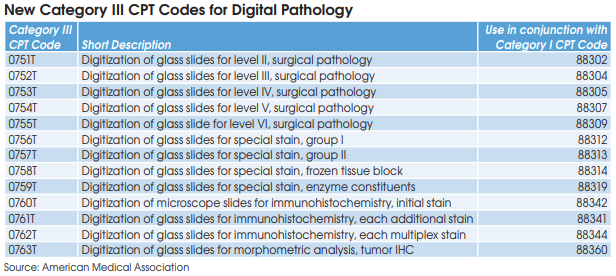
announced 13 new digital pathology add-on codes effective on January
1, 2023. The new digital pathology Category III CPT codes will be used
to report additional clinical staff work and service requirements associated
with digitizing glass slides for primary diagnosis.

Introduction of the codes will allow CMS to monitor the usage of digital
pathology. However, no relative value units (RVUs) or national payment
rates have been assigned to the new codes.

“It’s an important first step, but widespread use in clinical practice will
need to be demonstrated before the new codes are moved to Category I
and assigned RVUs,” notes Jonathan Myles, MD, Chair of the Council
on Government and Professional Affairs at the College of American
Pathologists (CAP).

The new digital pathology add-on codes are linked with 13 of the most commonly billed pathology procedures, including CPT 88305 (Level IV-Tissue Exam). CAP’s Myles says that the new add-on codes should only be reported when used for clinical diagnosis and not for things like archiving slides, training or validation of AI algorithms, or tumor board conferences. “It’s clear that digital pathology will be a part of the practice of pathology and lab medicine, but it has to be proven to be in widespread clinical use to gain Medicare reimbursement,” says Myles.

Assuming that digital pathology volumes prove to be significant, the very earliest that CMS could  assign RVUs and establish national payment rates for the new add-on codes would be for an effective date of January 1, 2024, notes Laboratory Economics. However, the process is more likely to take at
least a few years. In the meantime, each individual Medicare Administrative Contractor (MAC), as well as private insurers, could establish their own payment rates, but are not required to do so.

Many pathology labs in the United States are experimenting, but very few have gone fully digital, according to Michael Rivers, Vice President and Lifecycle Leader for Digital Pathology, Roche Tissue Diagnostics (Santa Clara, CA). “Digitization is a means to an end. It will allow the application
of innovative AI solutions to pathology images and ultimately integrated multi-modal analysis of patient cases combining anatomic pathology, clinical lab and gene-sequencing data,” says Rivers.

“My prediction is that if the Category III codes are converted to Category I code status, in the future Medicare could potentially reimburse the new add-on codes at roughly 3% to 5% of the global rates for related existing codes,” says Erick Lin, MD, PhD, Senior Director, Medical Affairs, PathAI (Boston, MA). Thus, the add-on code for digitizing one unit of CPT 88305 (current global rate of $72) could be reimbursed at between $2 and $4. The key is for all pathology labs to be aware of the new add-on codes, prepare systems to report, and then begin reporting the new codes effective January 1, 2023. If all clinical utilization is appropriately reported on claims, it can help facilitate Medicare’s establishment of national reimbursement rates, explains Lin.

“Although digital pathology, including usage of AI algorithms, could improve pathologist efficiency, this should not be the sole focus of reimbursement calculations. Digital pathology helps labs and pathologists expand their network of brainpower through greater access to information,
second opinions and subspecialist expertise. This ultimately could lead to optimized diagnostic decision-making and inherently leads to better patient management,” according to Esther Abels, Chief Clinical and Regulatory Officer, Visiopharm Corp. (Westminster, CO) and President of the Digital Pathology Association (Carmel, IN).

California Lab Owners Indicted For $214 Million Medicare Test Fraud

California Lab Owners Indicted For $214 Million Medicare Test Fraud

California Lab Owners Indicted For $214 Million Medicare Test Fraud

The U.S. Department of Justice has indicted Imran Shams and Lourdes Navarro, both 63 and owners of Matias Clinical Laboratory (Baldwin Park, CA), for their alleged roles in a $214 million Medicare billing fraud scheme.

The DOJ says that the married couple arranged for Matias to pay kickbacks to third-party marketers in exchange for specimens and test orders. Matias would then perform testing and pay the marketers a percentage of the reimbursements it received, including from the Medicare program.

Matias (dba Health Care Providers Lab) billed the Medicare program for $214 million of lab test claims between August 2018 and March 2022. This amount included $143 million of fraudulent claims for Covid-19 and respiratory pathogen tests that were submitted without regard to medical necessity, according to the DOJ. As a result of these alleged fraudulent claims, Matias received total Medicare payments of $29 million, including $18 million for Covid-19 and respiratory pathogen tests.

The DOJ alleges that Shams and Navarro used the Pandemic for their own financial gain by bundling Covid-19 tests with more expensive respiratory testing, irrespective of whether the testing was medically necessary.

DOJ says that Shams and Navarro transferred money from Matias to shell companies, Nurse Plus and Proworx, to launder money. The pair then withdrew this money to fund real estate transactions and to purchase luxury items and goods and services for their personal use.

Furthermore, the DOJ says that Shams fraudulently concealed his role at Matias and his prior criminal convictions. Shams had been excluded from all participation in Medicare since being convicted in 2000 for felony grand theft related to Medicare and Medi-Cal billing fraud.

Separately, Laboratory Economics notes that the HRSA uninsured program has paid Matias/Health Care Providers Lab $2 million for Covid-19 testing plus another $15.9 million for treating Covid-19 patients.

MT Salaries Skyrocket As Labs Struggle To Find MTs

MT Salaries Skyrocket As Labs Struggle To Find MTs

MT Salaries Skyrocket As Labs Struggle To Find MTs

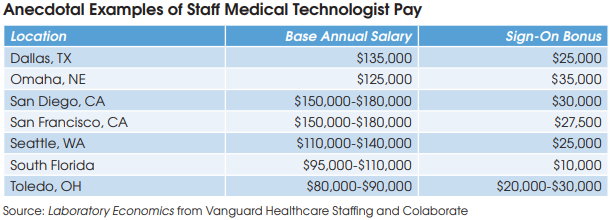
Today, laboratories are offering salaries and sign-on bonuses to medical technologists (MTs) that have never been seen before. In the San Francisco Bay Area and San Diego, lab clients are paying salaries as high as $150,000 and $180,000 to attract staff MTs with sign-on bonuses of more than $25,000, according to Ed Dooling, Chief Executive of Vanguard Healthcare Staffing (Sparta, NJ). He says MT salaries offered by independent labs in some markets have roughly doubled since the start of the pandemic.

PCR analyzers and Covid-19 test reagents were the bottleneck in the early months of the pandemic, but staffing shortages have proven to be a bigger and more persistent challenge. The pipeline of new MTs was disrupted as many labs temporarily shut down their clinical training rotations during the pandemic. In addition, older MTs retired to avoid exposure or got burned out due to extraordinary overtime demands. A huge increase in the number of new lab formations resulted in an intense competition for MTs, according to Dooling.

For example, independent labs in Toledo, Ohio are offering MT sign-on bonuses of $20,000 to $30,000 with salaries in the range of $80,000 to $90,000, according to Mason Shaw, Scientific Talent Recruiter at Vanguard. He notes that pre-pandemic salaries had ranged between $50,000 and $75,000 in this market.

Shaw notes that the length of time a new MT hire must stay before a sign-on bonus is paid varies by the lab company. “I have heard of a full year, 6 months, or 3 months, it depends on the offer and the negotiation.”

In addition, Shaw says that traveling MTs filling 3- to 12-month temporary positions are now being paid as much as $90 per hour. Pre-pandemic rates had averaged roughly $50-65 per hour for traveling MTs.

“Lab employees had always been treated like the red-headed stepchildren of healthcare. But the pandemic has raised their recognition and pay,” says Shaw.

Separately, Kevin Hunter, President of Colaborate (Tampa, FL), says his consulting firm helped set up 83 new Covid-19 PCR testing labs during the past two years. “We have seen $35,000 sign-on bonuses, significant relocation packages and starting salaries in the $125,000 range.”

For example, Hunter says that an independent lab in Dallas recently offered a salary of $125,000 plus a $25,000 sign-on bonus and six week’s paid vacation to hire an MT. “While some of this can be attributed to the retirement wave, the pandemic has put a tremendous burden on an
overworked staff, and with 50,000 new CLIA labs started since the beginning of Covid, there just aren’t enough workers to go around.”

Finally, Vanguard’s Dooling says that lab staff overtime hours have recently begun to decline as Covid test volumes have fallen. Nonetheless, he does not see the heightened MT salaries reverting to pre-pandemic levels. “It looks like this is the new normal.”

MT Salaries Skyrocket As Labs Struggle To Find MTs
Castle Biosciences To Buy AltheaDx For Up To $140 Million

Castle Biosciences To Buy AltheaDx For Up To $140 Million

Castle Biosciences To Buy AltheaDx For Up To $140 Million

Castle Biosciences (Friendswood, TX) has agreed to acquire AltheaDx (San Diego, CA) for $65 million in initial consideration consisting of $32.5 million in cash plus $32.5 million in stock. In addition, Castle could pay up to $75 million more in cash and stock if AltheaDx hits certain revenue targets over the next three years and gets expanded Medicare coverage for its IDgenetix
test. The deal is expected to close this summer.

AltheaDx markets a laboratory-developed pharmacogenomic test under the brand name IDgenetix. The cheek-swab test analyzes a panel of 15 genes to help doctors make prescription recommendations for patients with depression. The test is performed at AltheaDx’s CAP-accredited laboratory in San Diego. The Medicare program has covered IDgenetix since the fall of 2020 at a rate of $1,569 (CPT 81479: unlisted molecular pathology procedure).

AltheaDx, which has 40 employees, generated revenues of less than $1 million in 2021. Castle anticipates that AltheaDx will record $1-3 million of revenue in 2022.

Privately-held AltheaDx’s largest investors include Alma Life Sciences, Ally Bridge Group and WuXi Healthcare Ventures. AltheaDx filed for an initial public stock offering in December 2014, but shelved the proposed stock sale in early 2015.

Castle, which has 345 employees, is headquartered in Friendswood, Texas (near Houston) and operates CLIA-certified labs in Phoenix and Pittsburgh. Its lead testing product is DecisionDxMelanoma, which analyzes 31 genes to predict metastatic risk in patients diagnosed with cutaneous (skin) melanoma. DecisionDx-Melanoma is an Advanced Diagnostic Laboratory Test (ADLT) that is reimbursed by Medicare at $7,193 (CPT 81529).

For the full year ended December 31, 2021, Castle reported a net loss of $31.3 million versus a net loss of $10.3 million in 2020; revenue increased by 50% to $94.1 million.

High Claims Denials for Pharmacogenomic Testing

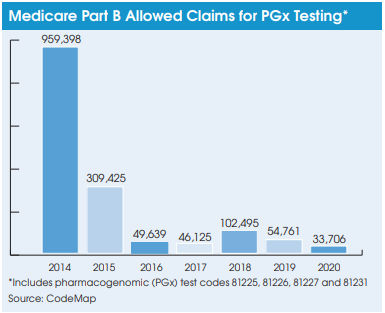
To date, pharmacogenomic testing for medication selection has been a tough market for labs providing this service. The volume of allowed Medicare Part B carrier claims for four key codes used to bill for pharmacogenomic testing (aka cytochrome p450; CPT 81225, 81226, 81227 and 81231) declined from a combined total of 959,398 allowed claims in 2014 to 33,706 allowed claims in 2020, according to data from the coding and reimbursement firm CodeMap (Chicago, IL). Furthermore, CodeMap data show that denial rates for these pharmacogenomic testing codes ranged from an average of 26% (2014) to 85% (2019) over the seven-year period. This compares with average claims denials rates of less than 10% for most routine clinical lab tests.

Biopsy Client Database for Pathologists

Biopsy Client Database for Pathologists

Biopsy Client Database for Pathologists

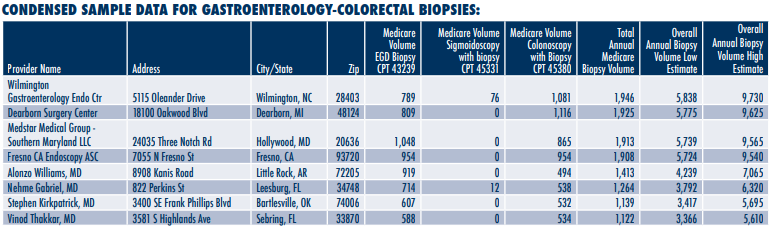
Laboratory Economics is offering a database of 50,000+ specialty physicians and ambulatory surgery centers that perform biopsies that lead to pathology referrals. The database includes annual Medicare Part B biopsy volumes for 2019 plus estimated overall biopsy volumes for each provider for 2021.

The database comes in easy-to-use and searchable Excel spreadsheets. It includes detailed biopsy volume figures for seven key specialty physician categories, including Breast Cancer (4,000+ providers), Cervix (600+ providers), Dermatology (18,000+ providers), FNA Biopsies (3,900+ providers), Gastroenterology/Colorectal (20,000+ providers), Urology/
Prostate (5,500+ providers) and Lung (2,000+ providers).

THE DATA IS PRESENTED IN A USER-FRIENDLY EXCEL SPREADSHEET AND INCLUDES:

• National Provider Identifier (NPI)
• Provider Name
• Address
• Specialty (Breast, Cervix, Dermatology, FNA Biopsies, Gastro/Colorectal,          Lung and Urology/Prostate)
• Specific Annual Medicare Biopsy Volume by CPT Code (2019)
• Overall Annual Biopsy Volume Estimates (2021)

PROVIDE YOUR SALES REPS WITH THE DATA THEY NEED TO SUCCEED! • Data for all 50 states and Puerto Rico
• Find new biopsy referral clients to grow your sales
• Create targeted lists by location or specialty to focus on your best opportunities
• Identify underserved markets for geographic expansion
• Save time and money by using accurate, complete and consistent data