Technical Rates for Many Pathology Services To Get Small Boost Under Proposed MPFS

Technical Rates for Many Pathology Services To Get Small Boost Under Proposed MPFS

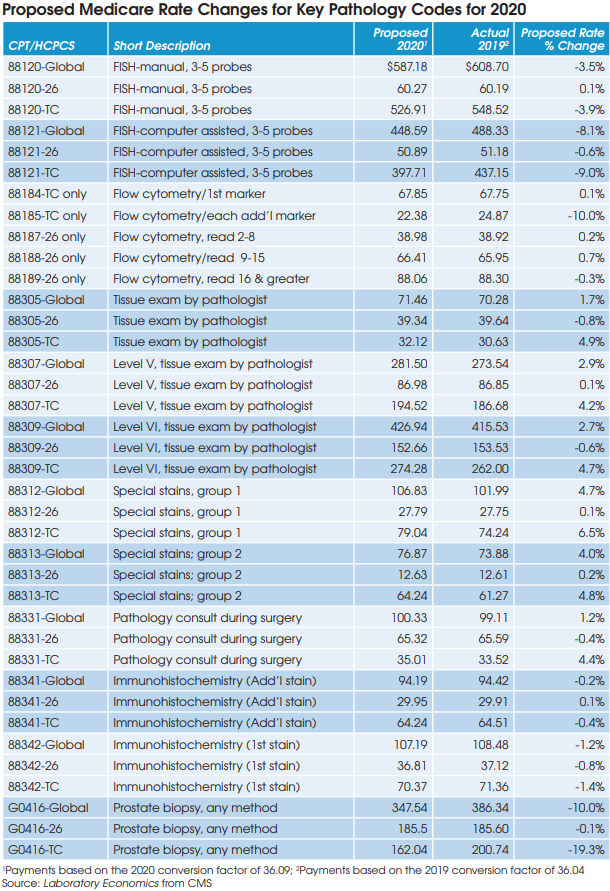
The Proposed Medicare Physician Fee Schedule (MPFS) for 2020 includes a 5% hike to the technical component for CPT 88305, which, if finalized, would raise it to $32.12. Meanwhile, the rate for the professional interpretation is being lowered by a proposed 1% to $39.34. Overall, the global rate for CPT 88305 will increase by a proposed 2% to $71.46.

In general, technical component fees for many key surgical pathology
services (e.g., CPT 88305, 88307 and 88309) and special stains (e.g., CPT
88312 & 88313) are proposed to increase, while most professional interpretation rates are set for no change or small reductions.

Meanwhile, a few areas where pathologists and labs will see significant
rate reductions are cytopathology, flow cytometry and prostate biopsies.

ACLA Wins Appeals Court Decision; HHS Likely To Request Rehearing

ACLA Wins Appeals Court Decision; HHS Likely To Request Rehearing

ACLA Wins Appeals Court Decision; HHS Likely To Request Rehearing

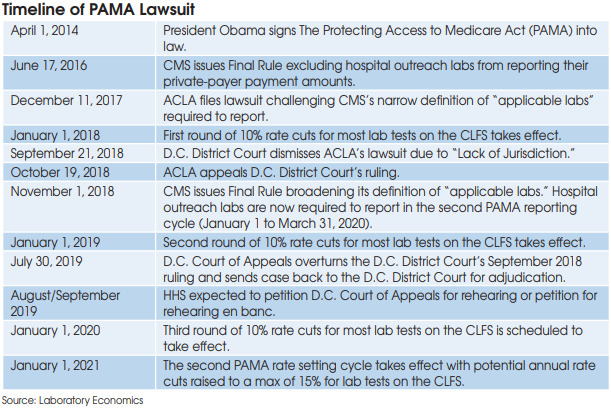
On July 30, the U.S. Court of Appeals for the District of Columbia ruled in favor of the American Clinical Laboratory Assn. (ACLA) in its suit against the U.S. Department of Health and Human Services (HHS) regarding implementation of the Protecting Access to Medicare Act (PAMA). The ruling overturned a D.C. District Court decision that dismissed ACLA’s lawsuit on the grounds that PAMA law prohibits judicial review of CMS’s “establishment of payment amounts” for clinical lab tests.

However, before the case goes back to D.C. District Court for review on its
merits, HHS is likely to request either a rehearing of the D.C. Court of Appeals’ three-judge panel decision or petition for a rehearing en banc from a broader panel of judges.

The D.C. Court of Appeals concluded that the statutory provision stripping jurisdiction to review payment amounts does not cover the statute’s data-collection provision. It ruled that the case be sent back to D.C. District Court to determine whether or not HHS/CMS violated PAMA by excluding hospital outreach labs from the first private-payer payment survey used to set Medicare CLFS rates for 2018 to 2020.

HHS has 45 days to petition for either a rehearing or rehearing en banc. The D.C. Court of Appeals has ordered that the case be held from being sent back to the D.C. District Court “until seven days after disposition of any timely request for rehearing or petition for rehearing en banc.”

It’s unlikely that any request by HHS for a rehearing will be granted, but the process will delay final resolution of the lawsuit, which is now approaching two years since initially being filed in late 2017.

More likely than not, the D.C. Court of Appeals will uphold its initial decision and send the lawsuit back to D.C. District Court. But the D.C. District Court proceedings could be lengthy, taking anywhere from six months to more than two years, before a decision is rendered.

Nonetheless, the Appeals Court decision is a victory for ACLA that will put pressure on HHS/CMS to negotiate with ACLA for a potential settlement of the lawsuit. ACLA and its biggest members, LabCorp and Quest Diagnostics, are lobbying hard to delay the next private-payer payment data reporting period (currently scheduled for January 1 to March 31, 2020) by one year. In addition, the lab industry wants CMS to use statistical sampling when it calculates new CLFS rates for 2021 to ensure that all lab segments (independents, hospital outreach labs and POLs) are properly represented.

Top 20 Medi-Cal Laboratories

Top 20 Medi-Cal Laboratories

Top 20 Medi-Cal Laboratories

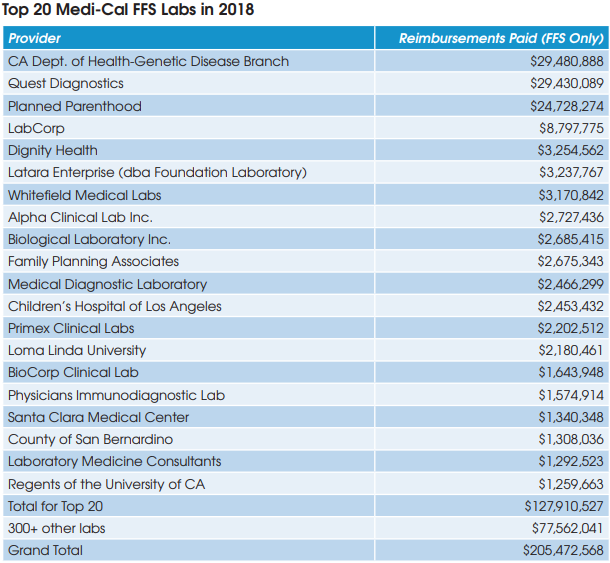
The largest Medi-Cal lab provider is The Genetic Disease Screening Program (GDSP) of the California Department of Health, which received $29.5 million of Medi-Cal FFS payments in calendar year 2018, according to the latest available data from DHCS. The Genetic Disease Screening Program provides prenatal and newborn testing services to Medi-Cal recipients.

Quest Diagnostics is second largest, with $29.4 million of Medi-Cal FFS payments. Planned Parenthood, which tests for sexually transmitted diseases, received $24.7 million, followed by LabCorp at $8.8 million.

The largest academic medical centers and hospital outreach labs on the list are Dignity Health, with $3.3 million of payments, followed by Children’s Hospital of Los Angeles, $2.5 million, and Loma Linda University, $2.2 million.
In total, the top 20 lab organizations collected $127.9 million of Medi-Cal lab test payments for FFS patients in 2018.

Debt Collection Company Hack May Affect 20+ Million Patients

Debt Collection Company Hack May Affect 20+ Million Patients

Debt Collection Company Hack May Affect 20+ Million Patients

Aweb payment page operated by American Medical Collection Agency
(AMCA-Elmsford, NY) has been hacked and may have exposed personal data on 20+ million patients from at least three commercial lab companies: Quest Diagnostics, LabCorp and BioReference Labs. AMCA, which also does business under the name Retrieval-Masters Credit Bureau, is a third-party debt collector with a reputation for aggressively pursuing patients for past due bills.

The hack was initially discovered in late February by the web payment
security monitoring firm Gemini Advisory (New York City), when they
found credit card information from patients linked to AMCA being sold
on a darknet marketplace. Gemini believes the AMCA hack may turn out
to be the largest medical breach of 2019.

Quest Diagnostics says that it was notified by AMCA of the data breach on May 14. AMCA said that an “unauthorized user” had gained access to social security numbers, credit card numbers, bank account information and other sensitive data from up to 11.9 million Quest patients between August 1, 2018 and March 30, 2019. Quest says that patient lab test results are not provided to AMCA and were therefore not affected by the hack. Quest has suspended sending collection requests to AMCA.

LabCorp says the data breach may have affected 7.7 million of its patients referred to AMCA. LabCorp has ceased sending new collection requests to AMCA and stopped the agency from working on any of its pending collection requests.

OPKO Health Inc. says that 422,600 of its patients may have been impacted by the hack through its subsidiary, BioReference Laboratories (Elmwood Park, NJ). BioReference has not sent any new collection requests to AMCA since October 2018, and has requested that it stop working on any pending collections.

In a statement, AMCA said it was notified of a potential data breach by a security compliance firm (i.e., Gemini) that works with credit card companies, which resulted in the collections agency conducting an internal review and then taking down its web payment page. As of early June, Gemini said that it can verify more than 200,000 compromised payment records related to the breach, and that more records are continually being added to dark web marketplaces.

Meanwhile, at least six state attorneys general—in Michigan, New York, Minnesota, North Carolina, Illinois and Connecticut—are now investigating the breach.

Public Lab CEOs Paid Average $4 Million

Public Lab CEOs Paid Average $4 Million

Public Lab CEOs Paid Average $4 Million

The chief executives at 17 publicly-traded lab companies were paid an average of $4 million each last year, according to an analysis of shareholder proxy statements by Laboratory Economics. Altogether, the 17 CEOs earned a total of $6 7.6 million, including $10.7 million from salary, $9.1 million from bonuses, $47.1 million from stock and option awards, and $751,270 from other compensation. In comparison, the average pathologist earned $308,000 in salary and bonus last year, according to the latest survey by Medscape.

LabCorp’s David King, age 62, was the highest paid lab CEO in 2018. He received total compensation of $12.3 million. In comparison, the median of the annual total compensation of all LabCorp’s employees was $43,230 in 2018. King’s compensation included: 1) salary of $1.2 million; 2) stock awards of $7.5 million; 3) stock options of $1.8 million; 4) incentive plan cash bonus of $1.6 million; and 5) other compensation of $189,068, which included financial planning services, 401K matching contributions, long-term disability insurance, use of a company car and aircraft, and home security services.

Quest Diagnostics’ Stephen Rusckowski, 61, was paid total compensation of $10 million last year versus median compensation of $46,749 for all other Quest employees. Rusckowski received: 1) a salary of $1.1 million; 2) stock awards valued at $4.7 million; 3) stock option awards of $3.1 million; and 4) cash incentives of $788,700. He also received $314,585 in perks, which included $87,414 for personal use of a company car and driver plus $100,000 for personal use of company aircraft.

Myriad Genetics’ Mark Capone, 56, got total compensation of $7.1 million versus median compensation of $77,814 for all other Myriad employees. Capone’s pay included: 1) salary of $852,000; 2) bonus and cash incentives totaling $817,920; 3) stock awards of $5.4 million; and 4) other compensation totaling $10,980, which included company-paid life insurance premiums and matching 401K contributions.

Exact Sciences’ Kevin Conroy, 53, was paid total compensation of $7 million last year versus median compensation of $98,783 for all other Exact employees. Conroy’s pay included: 1) salary of $695,800; 2) bonus and cash incentives totaling $794,952; 3) stock and option awards of $5.5 million; and 4) other compensation totaling $16,500.

Meanwhile, IRS 990 tax forms for 2017 (the latest year available) show that CEOs at the nation’s largest not-for-profit health systems receive compensation that often exceeds the pay earned by their counterparts at for-profit publicly-traded companies. For example, Ascension Health CEO
Tony Tersigni earned $17.5 million in 2017 in total compensation when base salary, bonuses and other compensation are added.

Kenneth Davis, MD, President and CEO of  Mount Sinai Health System (New York City) took home nearly $12.4 million in
cash compensation, including a supplemental executive retirement plan benefit of $8.3 million, in 2017. Jim Skogsbergh, President and CEO of Advocate Aurora Health, the largest health system in Illinois, received $11.7 million in 2017.