Latest Medi-Cal Private-Payer Payment Survey Underway

Latest Medi-Cal Private-Payer Payment Survey Underway

Latest Medi-Cal Private-Payer Payment Survey Underway

California’s Medi-Cal lab fee schedule has been pegged to private-payer rates since 2015. California’s Department of Health Care Services (DHCS) is currently in the midst of its fourth private-payer rate survey, which will be used to set Medi-Cal reimbursement rates for clinical lab and pathology services next year.

Approximately 300 independent labs, hospitals and pathology groups in California are required to submit their 10 lowest private-payer rates received in calendar year 2018 for approximately 270 high-volume lab and pathology CPT codes. The deadline for reporting the data to DHCS is June 30, 2019. The newly calculated Medi-Cal rates will be announced in June 2020 and will become effective July 1, 2020.

Labs are required to report if they have Medi-Cal paid claims volume of 5,000 or more per year, or Medi-Cal payments of $100,000 or more. Over the past three surveys, an average of about 100 labs per survey actually reported, representing less than 30% of the required labs. DHCS has the authority to suspend providers that are required to report, but fail to do so. However, no lab suspensions have occurred to date.

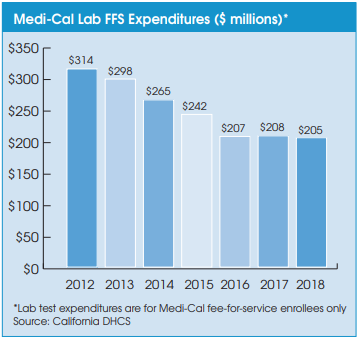
Medi-Cal’s transition to using private-payer lab rates has helped it slash its expenditures on lab testing for its 2.3 million fee-for-service (FFS) members from $265 million in fiscal year 2014 (ended June 30) to $205 million in fiscal year 2018. Medi-Cal lab expenditures have also been tempered by a steady movement toward Medi-Cal managed care plans. Managed care plans are
paid on a capitated basis, and they manage member care and negotiate and establish their own rates with their contracted providers. There are currently 10.7 million Medi-Cal members covered by managed care plans.

Medi-Cal currently reimburses clinical lab tests for FFS members at an average of approximately 79% of the Medicare CLFS for 2019. Medi-Cal rates for anatomic pathology services (i.e., CPT 88305) are set at approximately 60% of current Medicare Physician Fee Schedule rates.

The current Medi-Cal private-payer survey is especially interesting because it may provide an early glimpse into future Medicare CLFS rates. It will provide an early indication of the extent to which private health insurance plans in California were influenced by the first PAMAdirected 10% rate cut to the Medicare CLFS that took effect January 1, 2018.

It should also be noted that most
Medi-Cal providers, including labs,
remain subject to the Assembly Bill 97 (AB 97) 10% payment reduction that was enacted during the California’s budget crisis of 2011. Because AB 97 is a payment reduction, not a change to the actual rates, the 10% cut comes
off the listed Medi-Cal fee schedule rates. The 10% payment reduction authorized by AB 97 has no sunset date.

LabCorp CEO Dave King To Retire

LabCorp CEO Dave King To Retire

LabCorp CEO Dave King To Retire

LabCorp has announced that its CEO Dave King, age 62, will be retiring, effective October 31, 2019. Starting on November 1, King will become Executive Chairman of the Board through at least the end of 2020. He will also act as senior advisor to LabCorp’s new CEO, Adam Schechter, age 54, over this same period.

King served as CEO for 13 years, starting in January 1, 2007. He originally
joined the Company in September 2001 as Senior Vice President, General Counsel, and Chief Compliance Officer.

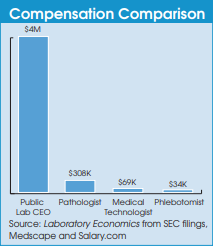
During the course of his 18 years with LabCorp, King has accumulated 442,660 shares of LabCorp with a current value of approximately $74 million. Since King has been CEO, the company’s earnings per share have increased at an average annual rate of 8.5%, while its share price has increased by 6.9% per year.

More recently, King has also been serving as CEO of LabCorp’s Diagnostics Division since January 1, 2019. A LabCorp spokesperson says the company “continues to seek a top-notch executive to lead our Diagnostics business and expects to have an announcement in the coming months.” In the meantime, King will continue to run LabCorp’s Diagnostics business until a new leader is named.

Schechter has served on LabCorp’s Board since April 2013, and was an Executive Vice President at Merck & Co. from 2010 to 2018.

When Will The EKRA Ban On Commission-Based Sales Reps Be Lifted?

When Will The EKRA Ban On Commission-Based Sales Reps Be Lifted?

When Will The EKRA Ban On Commission-Based Sales Reps Be Lifted?

As part of ongoing efforts to combat the nationwide opioid crisis, Congress enacted the SUPPORT for Patients and Communities Act (SUPPORT Act) effective October 24, 2018. As part of the SUPPORT Act, Congress enacted the Eliminating Kickbacks in Recovery Act of 2018 (EKRA) which banned all CLIA laboratories from paying commissions to sales reps based on the number of patients referred, test volume, or the amount billed to a commercial health plan (see LE, April 2019 and December 2018).

Despite the threat of substantial fines and/or imprisonment, most labs have not yet changed the way they pay their sales reps in the hope that the law will soon be amended and directed more narrowly at toxicology labs.

On an April 30 conference call, LabCorp CEO David King said he believed the EKRA law was misguided and unintentionally overbroad. “We have been working with the legislative leadership in the Department of Justice. There has been legislative amendment language submitted to the congressional committees of jurisdiction and it’s being evaluated by the Department of Justice to make sure that the fix that would address the over-inclusiveness of the language is acceptable to DOJ as well as to legislators. So we continue to be optimistic that we’re going to get this resolved, but we don’t have a good estimate on the timing.”

What Kind Of Company Is 23andMe?

What Kind Of Company Is 23andMe?

What Kind Of Company Is 23andMe?

A study led by researchers at the genetic testing lab company Invitae (San
Francisco, CA) found that 23andMe’s direct-to-consumer BRCA test for
hereditary breast cancer misses almost 90% of BRCA mutation carriers. 23andMe has been criticized for offering the test because it only analyzes three BRCA gene mutations out of a total of 1,000 other known mutations. The study results were presented at the American College of Medical Genetics and Genomics annual meeting in Seattle on April 4.

However, providing clinically relevant information to patients does not seem to be the primary goal of 23andMe. In fact, the company does not even operate a CLIA-certified lab—it subcontracts lab testing services to LabCorp. Rather, Laboratory Economics thinks 23andMe is simply a marketing company whose goal is to obtain patient DNA and demographic information which can be sold to pharmaceutical companies to help with drug research.

23andMe markets two testing services directly to consumers. Its ancestry testing service costs $99 and analyzes saliva samples obtained from at-home collection tubes. The samples are shipped to a LabCorp facility in North Carolina for genotyping. 23andMe takes the data provided by LabCorp to prepare ancestry reports that are made available to customers through online accounts in about 3-5 weeks. The report provides an estimate of your ancestry composition (e.g., 47.4% European, 41.8% East Asian & Native American, 5.2% Sub-Saharan African, et al.).

The company’s second product includes an ancestry report plus tests that assess your genetic risk for a variety of diseases (Parkinson’s, Alzheimer’s, Celiac Disease, breast cancer, et al.) and your carrier status for numerous inheritable diseases (Cystic Fibrosis, Bloom Syndrome, Canavan Disease, et al.). The report also gives generic lifestyle advice such as “avoid eating fast food,” and “sleep a healthy amount.” The cost for this combined service is $199.

FDA Clearance?
The FDA has granted 23andMe four separate clearances related to sending its genetic testing reports directly to consumers. The clearances did not involve instrument systems or reagents, just the issuance of result reports. FDA clearance was given after 23andMe showed that more than 97% of users understood that they should not use the company’s reports to make any changes to their treatment without first consulting their doctor.

Loss-Leader Testing
23andMe is clearly using its ancestry and genetic testing services as loss leaders. Its advertised list prices of $99 and $199 are often discounted by as much as 30% with free shipping. The company has also offered free testing to certain ethnic groups that are underrepresented in its DNA database, which now includes samples from more than five million people around the world. In fact, Laboratory Economics thinks that 23andMe is likely to be paying LabCorp close to, if not more than, $199 per specimen tested. LabCorp has stated that it makes above-average margins on testing services provided to 23andMe.

DNA Database For Sale
23andMe says that roughly 80% of the five million people who have purchased its service have given their consent to having their anonymized DNA and demographic data shared with third parties. And this is where 23andMe makes its money. The company has had research partnerships with numerous pharmaceutical companies including Alynlam, Biogen, Pfizer, Roche’s Genentech, Johnson & Johnson’s Janssen, Denmark-based Lundbeck and Germany-based Grünenthal Group.

And last year it announced its biggest deal to date, a four-year agreement to develop new drugs with GlaxoSmithKline (GSK). The companies agreed to split costs and profits equally, and Glaxo made a $300 million investment in 23andMe.

In addition, GSK contributed its LRRK2 inhibitor, a promising therapeutic target for some forms of Parkinson’s disease, into the partnership. GSK thinks 23andMe’s database of people who know their LRRK2 variant status will help the Parkinson’s program enroll patients on the way to clinical proof of concept.

Who owns 23andMe?
The company was co-founded by its CEO Anne Wojcicki, ex-wife of Google co-founder Sergey Brin, in 2006. Google was an early investor in 23andMe. In addition, 23andMe has raised more than $750 million from a combination of private equity investors (e.g., New Enterprise Associates, Mohr Davidow Ventures, Sequoia Capital) and pharmaceutical companies (e.g., Genentech, GlaxoSmithKline and Johnson & Johnson).

Largest Nursing Home Lab Company Seeks Bankruptcy Reorganization

Largest Nursing Home Lab Company Seeks Bankruptcy Reorganization

Largest Nursing Home Lab Company Seeks Bankruptcy Reorganization

Trident Holding Company (Sparks, MD), the nation’s largest nursing home lab operator, filed for Chapter 11 bankruptcy reorganization in the Southern District of New York on February 11. Trident, which employs 4,500 full-time workers and 660 people part time, provides mobile x-ray, ultrasound, and clinical lab testing services to some 12,000 nursing homes, assisted living and correctional facilities in more than 35 states. Its subsidiary lab companies include Diagnostic Laboratories and Radiology (Burbank, CA), Schryver Medical (Denver, CO) and U.S. Lab and Radiology (Brockton, MA).

Trident’s bankruptcy filing showed the company and its subsidiaries had a total of $785 million of secured debt outstanding and missed a $9.2 million interest payment that had been due January 31. Trident’s heavy debt burden became unsustainable due to declining occupancy rates at nursing homes, Medicare CLFS rate cuts, and a botched billing system transition.

Soon after the bankruptcy filing, Trident obtained a $50 million debtor-in-possession (DIP) financing loan from hedge fund Silver Point Capital (Greenwich, CT), which now has equity control. The loan will allow Trident and its subsidiaries to continue to operate, while it restructures both its debt and business operations. Full details in March 2019 issue of Laboratory Economics.