Tips For Negotiating Your Lab’s Next Reference Testing Contract

Tips For Negotiating Your Lab’s Next Reference Testing Contract

Tips For Negotiating Your Lab’s Next Reference Testing Contract

Reference (aka send-out) testing expenses average between 5% and 10% of the overall budget at most hospital laboratory departments. “Everybody thinks they are getting a good deal, but most have not wrung out the lowest prices available from their reference lab,” notes Steve Mattice,
President of the hospital lab consulting firm J.A. Mattice & Associates (Portland, OR). Below we highlight some of Mattice’s key tips and observations.

What’s the “hot list” in terms of send-out tests?
This is the list of 10 to 100 higher-volume send-out tests that the big reference labs (ARUP, Labcorp, Mayo and Quest Diagnostics) will discount the most in order to win a contract. But it’s a diversion because they offset their lower prices on the recognizable tests with much higher prices on lower-volume send-out tests. Each of the major reference labs is most focused on the overall profitability of their reference testing contracts.

How can hospitals negotiate for the best overall reference testing contract?
The key is knowing the lowest price that the major reference labs are willing to provide for each specific send-out test. We have helped negotiate more than 100 reference testing contracts over the past 30 years and have maintained a database of the lowest prices we have found for send-out tests from the four largest reference labs. Every time we find a lower price for the same test code, we keep track of it, and it becomes our new standard price for negotiations. When negotiating a new send-out testing contract, we will typically analyze the total annual costs for all send-out tests at a hospital client.

What kind of pricing variation is there?
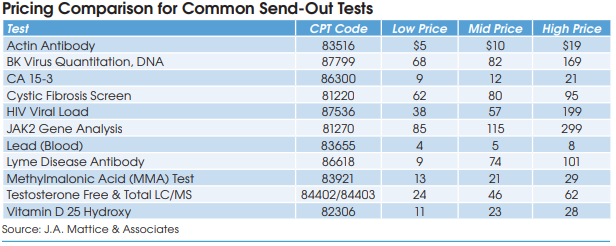
There is a wide variation (see table). For example, we have found that some hospitals pay their reference lab as little as $9 for Lyme Disease Antibody tests (CPT 86618), while others pay as high as $101. It’s not like shopping at the supermarket where you can easily compare prices. In reference testing, like most of healthcare, nobody knows what the other guy is charging.

What kind of savings are you typically able to achieve?
Historically, we have averaged in the range of 23% to 27% savings for each new three-year reference testing contract. However, over the past year, labs have begun to experience inflationary pressure on wages, reagents, paper supplies, courier services, etc. As a result, we’ve started to see the big reference labs draw a harder line on pricing.

Have there been any new entrants in reference testing to challenge the “big four?”
There are a handful of large health systems and academic medical centers competing on a regional basis and Sonic Reference Laboratory has been making some inroads into the market over the past few years.
Swedish Flag

New Lab Formations Continue To Boom

New Lab Formations Continue To Boom

New Lab Formations Continue To Boom

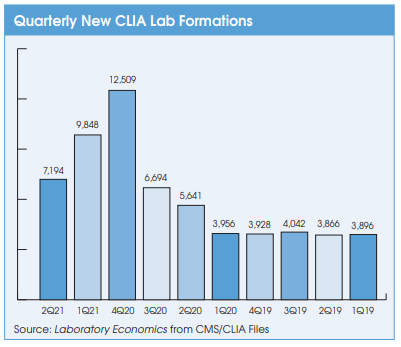
The extraordinary demand for Covid-19 PCR, antigen and antibody testing continues to fuel a record number of new CLIA-certified lab formations, according to the latest CMS data analyzed by Laboratory Economics. More than 7,000 new CLIA lab certificates were issued in the second quarter (April 1-June 30, 2021). The all-time high (12,000+ new CLIA labs) occurred in the fourth quarter of 2020. The boom has created a huge demand for lab workers that had already been in short supply before the pandemic. 

America’s Fastest-Growing Labs

America’s Fastest-Growing Labs

America’s Fastest-Growing Labs

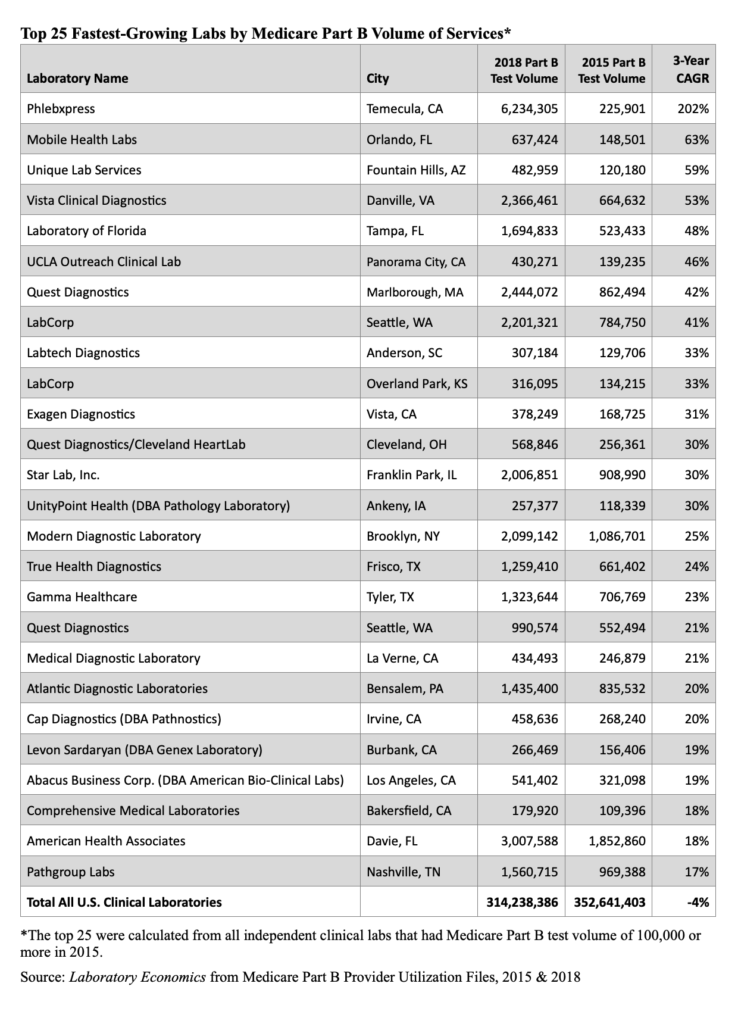
Phlebxpress (Temecula, CA) grew its Medicare Part B test service volume by 202% per year between 2015 and 2018, making it the fastest-growing independent lab company in America over the three-year period. Phlebxpress is a mobile phlebotomy company headquartered in Southern California that serves California, Nevada, and Texas. Its highest volume Part B test services included travel allowance (P9603 & P9604) and routine venipuncture (CPT 36415).

Two other mobile phlebotomy companies, Mobile Health Labs (Orlando, FL), up 63% per year, and Unique Lab Services (Fountain Hills, AZ), up 59% per year, rounded out the top three.

Two hospital-owned outreach labs, UCLA Outreach Clinical Lab (Panorama City, CA) and Pathology Laboratory (Ankeny, IA), owned by UnityPoint Health, were also among the fastest-growing lab companies.

Overall, some 2,900 independent clinical labs saw their Medicare Part B volume decline from 352.6 million test services in 2015 to 314.2 million test services in 2018. The decline was mostly driven by the introduction of new bundled codes for drug testing (G0480-G0483), which eliminated a large volume of individually billed drug tests.

Top 25 Fastest-Growing Labs by Medicare Part B Volume of Services

Laboratory Economics Issues Research Report on U.S. Anatomic Pathology Market

Laboratory Economics Issues Research Report on U.S. Anatomic Pathology Market

Laboratory Economics Issues Research Report on U.S. Anatomic Pathology Market

The publisher of Laboratory Economics has just released The U.S. Anatomic Pathology Market: Forecast & Trends 2019-2021. With this special report, you can tap into 150 pages of proprietary market research that reveals critical data and information about key business trends affecting the anatomic pathology market.

The report reveals that the anatomic pathology market (including Pap testing) now represents an estimated $18 billion of revenue with an annual growth rate of 3-4%. All data and trends are fully explained throughout the report, including 10-year historical data and a detailed three-year forecast.

The U.S. anatomic pathology market endured intense reimbursement pressure between 2013 and 2017. “However, the Medicare program has completed its evaluation of payment rates for all the key pathology codes and the reimbursement environment now appears stable,” according to Jondavid Klipp, Publisher of Laboratory Economics. “Furthermore, the introduction of new higher-priced molecular oncology tests linked to targeted cancer drugs is driving volume trends higher. As a result, the outlook for the U.S. anatomic pathology market is the best it’s been in the past 10 years.”

The report includes:

  • More than 100 charts and graphs
  • Industry size and growth rates
  • Detailed estimates for market subsets like prostate cancer testing, dermatopathology, lymphoma/leukemia and gastrointestinal
    pathology
  • Medicare claims data for 60 key pathology codes
  • Cervical cancer testing trends and pricing data
  • In-office histology lab trends
  • Detailed analysis of the digital pathology market
  • Results from Laboratory Economics’ exclusive Anatomic Pathology
    and Clinical Lab Trends Surveys from 2007 through 2019

Anatomic pathology companies featured in this report include: Aurora Diagnostics, Bako Diagnostics, CellNetix Labs, Exact Sciences, Genomic Health, InformDX, LabCorp/Dianon, Myriad Genetics, Mayo Clinic Labs, NeoGenomics, OPKO/BioReference Labs, PathGroup, Pathology Reference Laboratory, Poplar Healthcare, ProPath Services, Quest Diagnostics/AmeriPath and Sonic Healthcare USA.

The U.S. Anatomic Pathology Market: Forecast & Trends 2019-2021 is published by Laboratory Economics (www.laboratoryeconomics.com), an independent market research firm focused exclusively on the business of pathology and laboratory medicine.

Contact Information
Contact: Jondavid Klipp, President
Laboratory Economics
195 Kingwood Park
Poughkeepsie, NY 12601
Phone: 845-463-0080
www.laboratoryeconomics.com

Special New Year’s Report: Lab Execs Share Outlook for 2019

Special New Year’s Report: Lab Execs Share Outlook for 2019

Special New Year’s Report: Lab Execs Share Outlook for 2019

For an inside look at what may be in store for the clinical lab and pathology business this year, Laboratory Economics interviewed the top executives at a diverse group of 10 lab companies.

Not surprisingly, our interviews revealed that commercial insurers are using Medicare’s repricing of the CLFS as a pretext to cut their own rates. What is surprising (and alarming) is that some commercial insurers have demanded the full three-year phased-in ~30% CLFS reduction applied to their rates upfront immediately.

Labs are hoping to offset the pricing pressure by gaining economies of scale through geographic and test menu expansion. On the brighter side, the extreme pricing pressure that terrorized technical services for anatomic pathology seems to be over. Furthermore, molecular diagnostics and prescription drug monitoring continue to be high-growth markets.

  • Pricing pressure from both Medicare and commercial insurers
  • High volume growth in molecular diagnostics and prescription drug monitoring
  • Anatomic pathology reimbursement rates have stabilized
  • Hospital outreach labs benefiting from health system acquisitions of physician practices
  • Nursing home labs are restructuring and consolidating

Companies profiled in the January 2019 issue of Laboratory Economics include Sonic Healthcare USA, NeoGenomics, Health Network Laboratories, CellNetix, TriCore Reference Labs, Enzo Clinical Labs, Clinical Laboratory Services, CellMax Life, Psychemedics and Wisconsin Diagnostic Labs.