Harbert Wins Two Board Seats At Enzo Biochem

Harbert Wins Two Board Seats At Enzo Biochem

Harbert Wins Two Board Seats At Enzo Biochem

Two nominees from the Alabama investment management firm Harbert Discovery Fund (HDF) have won board seats at Enzo Biochem (New York City), following a vote at Enzo’s delayed shareholders meeting on February 25. Fabian Blank and Peter Clemens now represent 40% of the voting power on Enzo’s five-person board. Shareholders rejected Enzo’s proposal to
amend the company’s bylaws to increase the size of the Board (see LE, February 2020).

The board seat of Elazar Rabbani, PhD, Co-Founder, Chairman and CEO of Enzo Biochem, is set to expire at the next shareholders meeting in early 2021.

HDF owns 11.8% of Enzo’s outstanding shares, making it the company’s largest shareholder. HDF has been pressuring Enzo to sell its drug development business and focus on its clinical lab business.

Separately, Enzo reported a net loss of $7.7 million for the three months ended January 31, 2020, compared with a net loss of $8.4 million for the same period a year earlier. Total revenue was up slightly to $19.4 million versus $19.3 million.

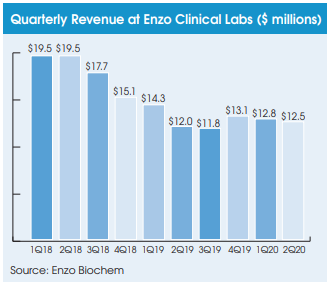
Enzo reported that its clinical lab division recorded revenue of $12.5 million for the quarter, up 4% from $12 million. Patient requisition volume was up 7%, while average revenue per requisition was down approximately 3%. Gross profit margin for Enzo’s clinical lab division was 18% in the most recent quarter versus 8% in the same year-ago period. Enzo attributed the margin expansion to cost cuts, including lowered outside reference testing expense and employee headcount efficiencies, partially offset by increased reagent cost from higher accession volume. On an annual basis, Enzo currently processes approximately 813,000 patient requisitions.

Enzo’s latest results suggest that the company’s clinical lab business has begun to stabilize after several years of severe pricing pressure related to the PAMA reimbursement cuts.

Swedish Flag
UnitedHealthcare Requiring Hospital Outreach Labs To Contract As Independent Reference Labs

UnitedHealthcare Requiring Hospital Outreach Labs To Contract As Independent Reference Labs

UnitedHealthcare Requiring Hospital Outreach Labs To Contract As Independent Reference Labs

UnitedHealthcare (UHC) says that hospital labs cannot bill for non-patient outreach tests under their hospital’s facility participation agreement.

UHC has had this policy in effect for more than one year. What’s new is that UHC now appears ready to actually enforce it. Effective May 1, 2020, non-patient lab test claims submitted by hospital outreach labs will be denied if billed under the hospital’s facility participation agreement, according to UHC’s Network Bulletin for February 2020. UHC says that hospital outreach labs must get credentialed and contracted as an independent reference lab in order to get their non-patient lab test claims paid.

Enforcement of this policy could potentially eliminate many hospital outreach labs from UHC’s network and dramatically reduce reimbursement
for those labs that do get contracted and paid under independent reference lab fee schedules, notes Scott Liff, President and CEO of Kellison &
Company (Cleveland, OH).

UHC Requiring Hospital Outreach Labs

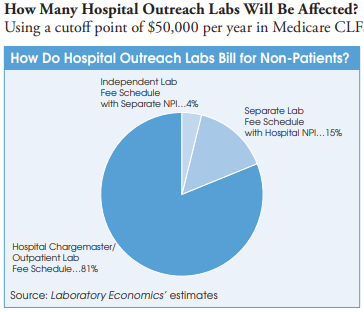
Liff says that the policy affects nearly all hospitals that provide non-patient lab outreach testing to UnitedHealthcare. The exception is roughly 100 hospital-owned independent labs (e.g., ACL Labs, Northwell Health, Tricore, et al.) that bill under their own distinct NPI and are already treated like independent reference labs with separate contractual agreements in place. In addition, a handful of the nation’s largest hospital-based outreach labs without their own unique NPI have also negotiated separate independent-lab-type fee schedules with private insurers.

However, most hospital outreach labs bill commercial insurance plans for non-patient lab tests using their hospital chargemaster and related outpatient payer contracts to get payment rates that typically range from 1x to 5x times the current Medicare CLFS. In some cases, hospital outpatient lab rates to private insurers are as high as nine times the Medicare CLFS. In contrast, Quest Diagnostics, LabCorp and independent labs are paid at rates well below the Medicare CLFS.

A UHC spokesperson says that the policy applies to all UHC commercial plans, fully-insured and administrative-services only (ASO). It does not apply to UHC’s Medicare or Medicaid plans. UHC covers a total of 27.8 million commercial plan members in the United States, including 8.6 million fully-funded health plan members and 19.2 million ASO members in self-insured employer plans. Among the states where UHC has its biggest share of the commercial insurance market are Nevada (66% share), Texas (32%), Arizona (25%), Connecticut (26%), Florida (23%), North Carolina (22%), New York (16%) and Illinois (16%).

Why Is UnitedHealthcare Doing This?
Liff believes the UHC initiative is designed to force hospital labs off using outpatient fee schedules for non-patient testing to reduced, market-based, reference lab fee schedules. This will significantly lower payments to hospital labs for non-patient testing.

Liff notes that credentialing and contracting with UHC as a commercial lab provider is not expected to be a quick process and might take as long as 90-180 days, if not longer, for hospitals to complete.

It’s important to note that hospital outreach labs do not have to change their licensure to an independent lab in order to continue providing non-patient lab services, but for reimbursement purposes the outreach lab will need to be recognized by UHC as a reference lab.

Liff adds that while it’s unclear if UHC intends to exclude certain hospital outreach labs from receiving contracts under this new initiative, hospital lab leaders should be wary of this possibility.

Will Other Commercial Insurance Plans Follow Suit?
Other private payers will be closely observing the response to UHC’s policy, says Jeff Myers, Vice President of Consulting at Accumen Inc. (Phoenix, AZ). He notes that private payers have been searching for effective ways to normalize payment rates made to hospitals, many of which have enjoyed premium payments from private payers for lab services for decades.

Myers adds that until Anthem’s “rate alignment” strategy in 2019, efforts to lower hospital rates had been largely ineffective. But he believes that UHC’s policy has the potential to have an even greater impact because it forces hospital labs to credential and contract with UHC as reference labs, or face denied claims for their non-patient lab testing.

Meanwhile, Myers anticipates that those hospitals that do credential and contract with UHC as a reference laboratory will likely see their non-patient lab payment rates decrease by 50% or more.

Hospitals that are already providing non-patient lab testing at competitive rates will have a distinct advantage over hospitals that have yet to make the market adjustment, adds Myers.

Swedish Flag

LabCorp Reports Full-Year 2019 Financial Results

LabCorp Reports Full-Year 2019 Financial Results

LabCorp Reports Full-Year 2019 Financial Results

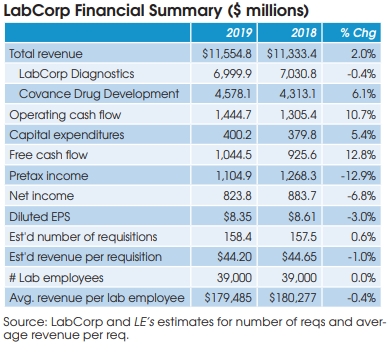
LabCorp (Burlington, NC) reported net income of $823.8 million for the full-year 2019, down from $883.7 million in 2018. LabCorp’s overall revenue increased by 2.0% to $11.6 billion in 2019.

Revenue from LabCorp’s lab testing business decreased by 0.4% to $7 billion in full-year 2019. This year LabCorp expects its lab testing business to increase its revenue by 0.5% to 2.5%. This guidance includes a -1.3% impact from PAMA and -0.9% from UnitedHealth’s nonrenewal of the BeaconLBS contract in Florida.

LabCorp expects revenue from its Covance Drug Development division to grow by 7% to 9.5% in 2020.

On February 13, LabCorp held a conference call with analysts and investors. Here are some comments on a few key topics from CEO Adam Schechter.

Impact from PAMA
Schechter said that the PAMA rate cuts reduced the company’s lab testing revenue by approximately $100 million in 2019. He expects a similar $100 million revenue loss from PAMA this year and again in 2021.

UnitedHealth’s Preferred Laboratory Network (PLN)
“I don’t assume there’ll be a significant shift [to PLN labs] in 2020 because they’re rolling it out as we speak….If it works for United, I think that other organizations may see this as an opportunity to help them reduce their laboratory costs by moving over business to a lab like ours.”

Hospital Lab Acquisitions
“As I look at the hospital tuck-in acquisitions, I can tell you that our list is long. There are many discussions that we’re having around the country with both local and regional labs and hospitals… I believe over time it [hospital lab deals] will begin to accelerate, particularly as they feel the continued impact from PAMA.”

Direct to Consumer Genetic Testing
“We saw a significant decline in 2019 versus 2018. It’s now a very small amount of our total volume and of our total revenue and operating income.” Laboratory Economics notes that LabCorp has had a contract to provide genotyping services to 23andMe Inc. (Sunnyvale, CA) since 2008. After years of strong demand for
its ancestry and health testing services, 23andMe recently laid off 100 employees, or 14% of its workforce, citing a slowdown in consumer demand.

Swedish Flag
Quest Reports Full-Year 2019 Financial Results

Quest Reports Full-Year 2019 Financial Results

Quest Reports Full-Year 2019 Financial Results

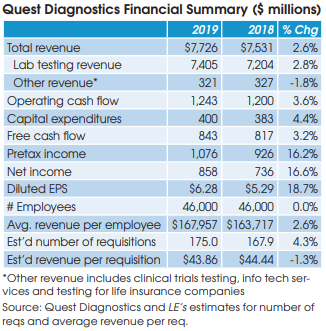
Quest Diagnostics reported net income of $858 million for full-year 2019, up from $736 million in 2018. Quest’s overall revenue increased by 2.6% to $7.726 billion, with acquisitions contributing more than 2% to revenue growth. Quest’s average revenue per requisition decreased by 1.3% to an estimated $44.86 per req. A summary of key topics discussed by CEO Steve Rusckowski and CFO Mark Guinan on a January 30 conference call follows.

Volume Growth
Overall, Quest’s gene-based and esoteric testing grew by approximately 5% to $2.5 billion in 2019. The growth drivers included drug monitoring, tuberculosis testing (QuantiFERON and T-SPOT), Hemepath, blood cancer testing and Cardio IQ cardiovascular testing, according to Rusckowski.

Immunoassay Vendor Consolidation
Siemens Healthineers has won a contract to provide up to 120 Atellica Solution immunoassay analyzers to 19 esoteric and core laboratories owned by Quest in the U.S. The Atellica system will also be installed at the new 250,000-square-foot lab that Quest is building in northern New Jersey. The consolidation to one immunoassay vendor is expected to save Quest $35 million per year.

Increased Competition for Hospital Send-Out Testing
Guinan said that hospitals are focusing more on pricing when selecting a reference lab. “In the past you might extend the [reference lab] contract with the understanding that you had a good reasonable price and they had good quality and all those kind of things. More and more of these are going to RFP where there’s an opportunity for price competitors to come in and compete on price very highly.”

Wage Pressure
“We have pressure in some geographies to up our wages more than we have historically because we have to be competitive with other companies,” said Rusckowski. He noted that Quest employs about 12,000 phlebotomists, more than 3,500 couriers, and thousands of specimen processors. “And so, if you look at the front end of our value chain, that’s where we see some pressure.”

UnitedHealth’s Preferred Laboratory Network                                                    Guinan said that United was focusing on how to reduce out-of-network usage. “They’ve done a number of things to try to reduce that, including sharing that information with members of the PLN, where we can go out and target some of those accounts and explain to the physician why there’s a benefit in steering patients to a preferred lab member.”

Guinan said that United began rolling out the PLN benefit, which offers members zero-dollar out-of-pocket cost for lab tests, to its fully-insured plans in January. “And then there’s the sponsored plans, which is the next step. So this is a long-term initiative that is certainly reaping some benefits. But it’s not in terms of a steep change where this is going to overnight move on dramatically.”

Swedish Flag

Harbert Wins Two Board Seats At Enzo Biochem

Enzo Delays Shareholder Meeting; Harbert Files Lawsuit

Enzo Delays Shareholder Meeting; Harbert Files Lawsuit

Enzo Biochem (New York City) has delayed its annual shareholder meeting, originally scheduled for January 31, until February 25. The move comes as Enzo’s executives are engaged in a bitter battle with the Alabama investment firm Harbert Discovery Fund (HDF) over board seats and the
strategic direction of the company

Enzo says the delay is needed so that shareholders can consider a new proposal to keep President Barry Weiner on its board by increasing the size of the board from five to six directors. In addition, Enzo wants to add a seventh board seat to be filled by an independent director to be identified in the near future.

HDF says that all three leading independent proxy advisory services had recommended voting in favor of HDF’s two board nominees, Fabian Blank and Peter Clemens. And that by January 28, three days before the election, with most of the expected votes cast, it was clear that both its nominees would win seats.

HDF has filed a lawsuit in Southern District of New York court against Enzo’s board, alleging it has engaged in “acts of entrenchment and misuse of the corporate machinery” to keep Barry Weiner on the board after most of the company’s shareholders had voted and it had become clear that Weiner would be removed.

“Recognizing that it was too far behind in votes to defeat HDF’s nominees, Enzo agreed in the January 28 Enzo Press Release to no longer oppose HDF’s nominees but instead would seek shareholder approval to expand the size of the board by at least one additional seat in a desperate attempt to keep Weiner on the board and reduce the influence of HDF’s nominees,” according to the lawsuit.

HDF says that Enzo has violated federal securities laws, and is seeking recompense for those actions which have cost hundreds of thousands of dollars in additional, unnecessary legal, proxy and other advisory fees. HDF says that its lawsuit also lays “a marker so that the director defendants’
gamesmanship stops.”

HDF owns 11.8% of Enzo’s outstanding shares, making it the company’s largest shareholder (see LE, January 2020).