Tips For Negotiating Your Lab’s Next Reference Testing Contract

Tips For Negotiating Your Lab’s Next Reference Testing Contract

Tips For Negotiating Your Lab’s Next Reference Testing Contract

Reference (aka send-out) testing expenses average between 5% and 10% of the overall budget at most hospital laboratory departments. “Everybody thinks they are getting a good deal, but most have not wrung out the lowest prices available from their reference lab,” notes Steve Mattice,
President of the hospital lab consulting firm J.A. Mattice & Associates (Portland, OR). Below we highlight some of Mattice’s key tips and observations.

What’s the “hot list” in terms of send-out tests?
This is the list of 10 to 100 higher-volume send-out tests that the big reference labs (ARUP, Labcorp, Mayo and Quest Diagnostics) will discount the most in order to win a contract. But it’s a diversion because they offset their lower prices on the recognizable tests with much higher prices on lower-volume send-out tests. Each of the major reference labs is most focused on the overall profitability of their reference testing contracts.

How can hospitals negotiate for the best overall reference testing contract?
The key is knowing the lowest price that the major reference labs are willing to provide for each specific send-out test. We have helped negotiate more than 100 reference testing contracts over the past 30 years and have maintained a database of the lowest prices we have found for send-out tests from the four largest reference labs. Every time we find a lower price for the same test code, we keep track of it, and it becomes our new standard price for negotiations. When negotiating a new send-out testing contract, we will typically analyze the total annual costs for all send-out tests at a hospital client.

What kind of pricing variation is there?
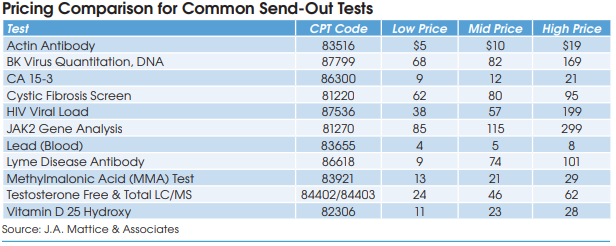
There is a wide variation (see table). For example, we have found that some hospitals pay their reference lab as little as $9 for Lyme Disease Antibody tests (CPT 86618), while others pay as high as $101. It’s not like shopping at the supermarket where you can easily compare prices. In reference testing, like most of healthcare, nobody knows what the other guy is charging.

What kind of savings are you typically able to achieve?
Historically, we have averaged in the range of 23% to 27% savings for each new three-year reference testing contract. However, over the past year, labs have begun to experience inflationary pressure on wages, reagents, paper supplies, courier services, etc. As a result, we’ve started to see the big reference labs draw a harder line on pricing.

Have there been any new entrants in reference testing to challenge the “big four?”
There are a handful of large health systems and academic medical centers competing on a regional basis and Sonic Reference Laboratory has been making some inroads into the market over the past few years.
Swedish Flag

New Lab Formations Continue To Boom

New Lab Formations Continue To Boom

New Lab Formations Continue To Boom

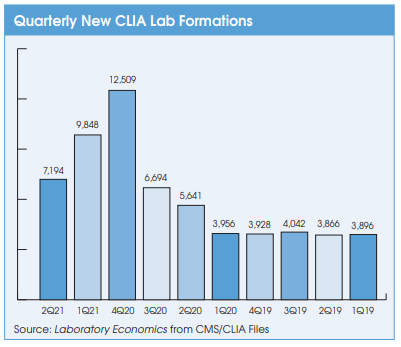
The extraordinary demand for Covid-19 PCR, antigen and antibody testing continues to fuel a record number of new CLIA-certified lab formations, according to the latest CMS data analyzed by Laboratory Economics. More than 7,000 new CLIA lab certificates were issued in the second quarter (April 1-June 30, 2021). The all-time high (12,000+ new CLIA labs) occurred in the fourth quarter of 2020. The boom has created a huge demand for lab workers that had already been in short supply before the pandemic. 

Apollo To Buy Sun Clinical Labs For $4 Million

Apollo To Buy Sun Clinical Labs For $4 Million

Apollo To Buy Sun Clinical Labs For $4 Million

Apollo Medical Holdings (ApolloMed-Alhambra, CA) has agreed to purchase a majority stake in Sun Clinical Laboratories (Sun Labs-El Monte, CA) for $4 million in cash. The deal is expected to close within three months.

Sun Labs is a small independent routine clinical lab with 19 patient service centers located across the San Gabriel Valley in southern California. Sun Labs was founded by its CEO Francis Sun in 1980.

ApolloMed is a publicly-traded company that manages 14 independent physician associations (IPAs) with 7,000 contracted physicians located primarily in California. Apollo’s IPAs have capitated contracts with insurers (Aetna, Anthem, Cigna, Humana, UnitedHealthcare, etc.) covering a total of 1.13 million members. ApolloMed, which is expanding into New York and Florida, anticipates growing to a total of 10,000 contracted physicians, two million covered lives, and $700 million of revenue by the end of this year.

Apollo had already been using Sun Labs for testing services. “As ApolloMed expands its geographic footprint, we see Sun Labs as a core partner in this expansion, growing the business and bringing high-quality lab services to more patients across the nation,” according to Kenneth Sim, MD,
Chairman and Co-Chief Executive of ApolloMed.

America’s Fastest-Growing Labs

America’s Fastest-Growing Labs

America’s Fastest-Growing Labs

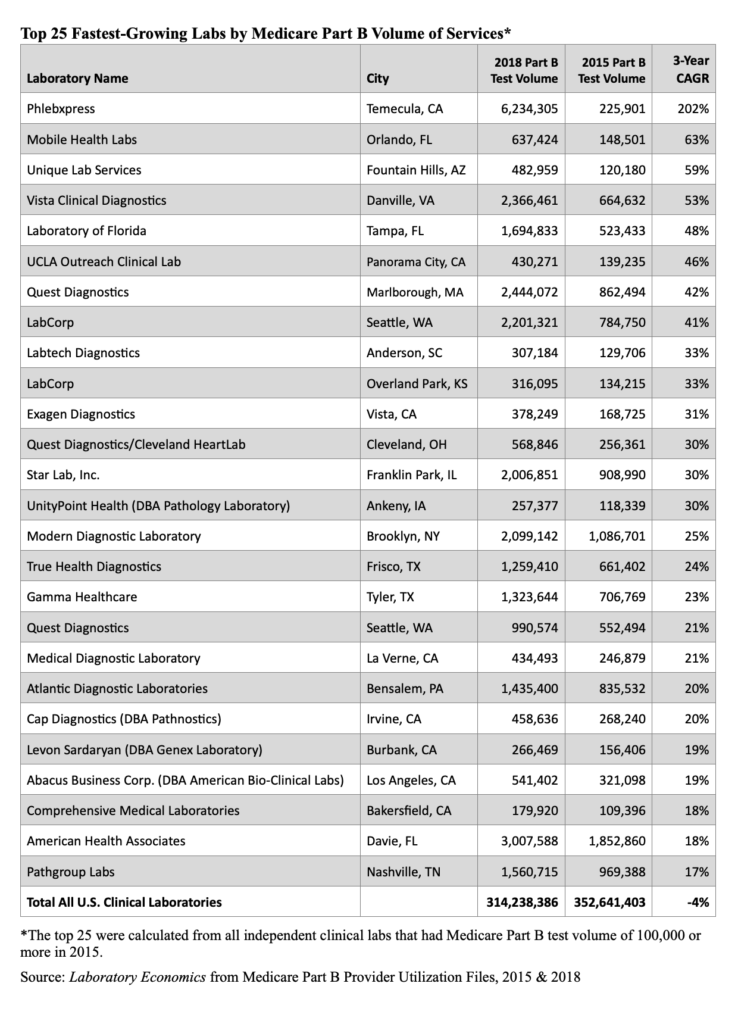
Phlebxpress (Temecula, CA) grew its Medicare Part B test service volume by 202% per year between 2015 and 2018, making it the fastest-growing independent lab company in America over the three-year period. Phlebxpress is a mobile phlebotomy company headquartered in Southern California that serves California, Nevada, and Texas. Its highest volume Part B test services included travel allowance (P9603 & P9604) and routine venipuncture (CPT 36415).

Two other mobile phlebotomy companies, Mobile Health Labs (Orlando, FL), up 63% per year, and Unique Lab Services (Fountain Hills, AZ), up 59% per year, rounded out the top three.

Two hospital-owned outreach labs, UCLA Outreach Clinical Lab (Panorama City, CA) and Pathology Laboratory (Ankeny, IA), owned by UnityPoint Health, were also among the fastest-growing lab companies.

Overall, some 2,900 independent clinical labs saw their Medicare Part B volume decline from 352.6 million test services in 2015 to 314.2 million test services in 2018. The decline was mostly driven by the introduction of new bundled codes for drug testing (G0480-G0483), which eliminated a large volume of individually billed drug tests.

Top 25 Fastest-Growing Labs by Medicare Part B Volume of Services

Sweden’s Controversial Covid-19 Strategy

Sweden’s Controversial Covid-19 Strategy

Sweden’s Controversial Covid-19 Strategy

Sweden never imposed a strict lockdown to combat Covid-19, unlike most other countries. The only official rules put in place are a ban on gatherings of 50 people or more and a ban on visitors to nursing homes.

The nation’s Chief Epidemiologist, Anders Tegnell, MD, PhD, says Sweden’s strategy is based on the assumption that Covid-19 isn’t going away any time soon, and that severe lockdowns can’t be maintained for very long and will prove to be ineffective over the long run. Strict lockdowns may temporarily contain the virus, but won’t prevent it from returning, according to Tegnell.

In an interview with Swedish Public Radio on June 24, Tegnell said that Sweden has followed the “classic pandemic model” that he had been discussing with international colleagues for 20 years. Tegnell characterized lockdowns as flying in the face of what is known about handling viral outbreaks. “It was as if the world had gone mad, and everything we had discussed was forgotten….The cases became too many and the political pressure got too strong. And then Sweden stood there rather alone.”

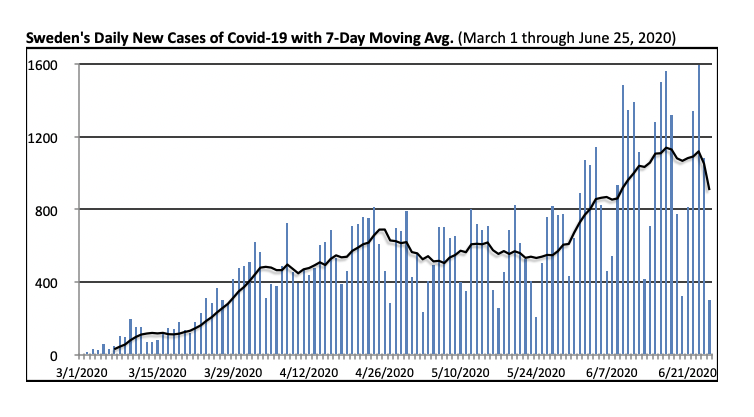
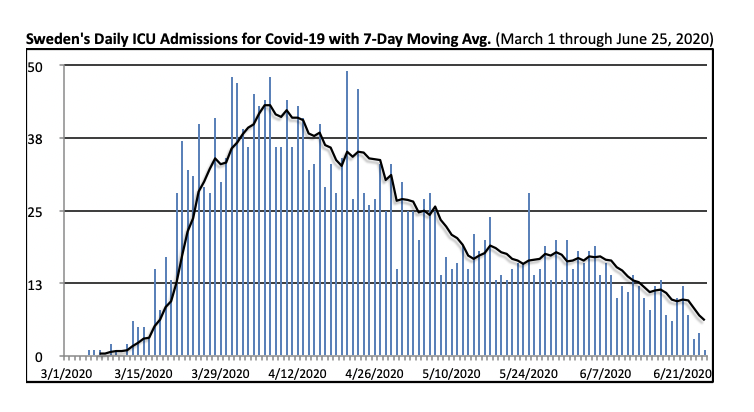
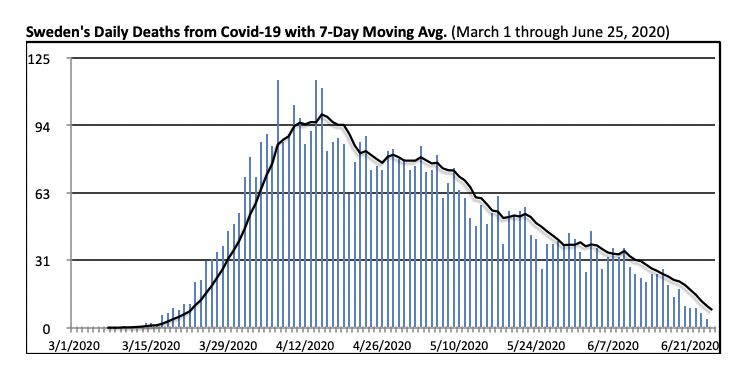
Sweden, which has a population of 10.1 million, has recorded 65,137 cases, 2,407 intensive care admissions and 5,268 deaths from Covid-19 as of June 25, according to the Public Health Agency for Sweden. More than half of the Covid-19 deaths in Sweden have occurred among its nursing home residents.

Covid-19 deaths in Sweden are much higher per capita than its nearest neighbors (Finland, Norway and Denmark), which had strict lockdowns. However, its per capita death rate is lower than some other European countries that had strict lockdowns, such as Belgium, Britain, Spain and Italy.

Sweden New Covid-19 Cases 7 day moving avg
Swedish Covid-19 ICU-Admissions
Daily Deaths Covid-19 Sweden