New Law For Medi-Cal Aimed At Eliminating Retroactive Recoupments

New Law For Medi-Cal Aimed At Eliminating Retroactive Recoupments

New Law For Medi-Cal Aimed At Eliminating Retroactive Recoupments

On July 27, California Gov. Gavin Newsom signed a comprehensive health care budget trailer bill (AB 133), which prevents future retroactive reimbursement reductions and recoupments from labs and pathology groups that occur due to “a lack of timeliness in Medi-Cal updating their rates.” In the past, Medi-Cal fee schedule rate changes have been chronically delayed, which has often led the program to seek retroactive recoupments from labs and pathologists—a major administrative and billing headache.

In addition, the new law has made a minor adjustment to the methodology used for setting MediCal fee schedule rates for clinical lab tests and pathology services. Beginning on July 1, 2022, Medi-Cal rates will be based on the lowest of the following: 1) the amount billed; 2) the charge to the general public; 3) 100% of the lowest maximum allowance established by the federal Medicare program for the same or similar services; or 4) a reimbursement rate based on an average of the lowest amount that other payers and other state Medicaid programs are paying for similar clinical laboratory or laboratory services.

The California Department of Health Care Services (DHCS) will not adjust rates currently established on the Medi-Cal fee schedule that do not exceed the limitations mentioned above, according to a DHCS spokesman. Some labs and pathologists had hoped the new law would raise their Medi-Cal rates to 100% of Medicare rates next year, but it does not.

The DHCS spokesman confirmed that the DHCS will continue to conduct its triennial rate survey and adjust rates based on the average of the lowest amounts third-party payers are paying. The next rate survey will be based on third-party payer data collected from calendar year 2021, reported in 2022 and effective in July 2023.

New Lab Formations Continue To Boom

New Lab Formations Continue To Boom

New Lab Formations Continue To Boom

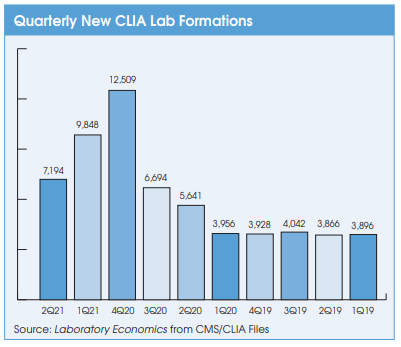
The extraordinary demand for Covid-19 PCR, antigen and antibody testing continues to fuel a record number of new CLIA-certified lab formations, according to the latest CMS data analyzed by Laboratory Economics. More than 7,000 new CLIA lab certificates were issued in the second quarter (April 1-June 30, 2021). The all-time high (12,000+ new CLIA labs) occurred in the fourth quarter of 2020. The boom has created a huge demand for lab workers that had already been in short supply before the pandemic. 

Medical Technologist Shortages Widespread

Medical Technologist Shortages Widespread

Medical Technologist Shortages Widespread

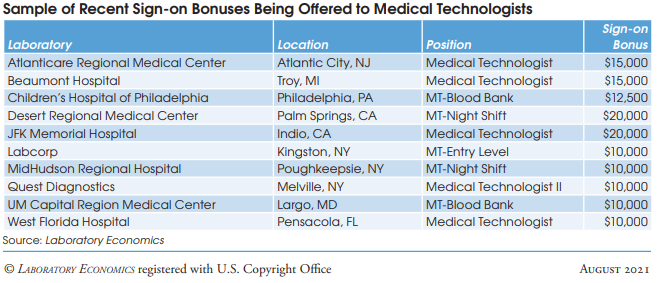
Medical technologists (MTs) have been in chronic short supply for at least the past 20 years. In the past, labs have used sign-on bonuses ranging from $2,000 to $5,000 to attract MTs. Last month, Laboratory Economics highlighted Alverno Laboratories (Hammond, IN) use of $10,000 sign-on bonuses to try to fill hundreds of open positions. We thought it was unusual, but it’s not. Both hospital labs and commercial labs across the country are offering sign-on bonuses ranging as high as $10,000 to $20,000 to fill open MT positions. Night shift and blood banking MT positions appear to be the hardest to fill. Laboratory Economics plans to take a deeper look at the lab industry’s worker shortage in next month’s issue.

Capital Digestive To Open Bigger Pathology Lab

Capital Digestive To Open Bigger Pathology Lab

Capital Digestive To Open Bigger Pathology Lab

Capital Digestive Care (Silver Spring, MD) has announced plans to relocate and expand its pathology lab to Silver Spring, Maryland. The new lab will be 21,000 square feet and is expected to open in early 2022. In addition, the new lab will become a Roche Diagnostics Center of Excellence and will be expanding its clinical diagnostics testing menu. Capital Digestive Care’s current lab is CAP accredited and located in Bowie, Maryland. Its Medical Director Jeffrey Baybick, MD, had founded an independent pathology lab (Bay Labs) in 2004 that was merged into Capital Digestive Care in 2009. Capital Digestive Care is the largest private practice gastroenterology group in the Mid-Atlantic. The group has 20+ offices in the greater Washington, DC area and includes more than 80 physicians, nurse practitioners and physician assistants, seeing 75,000+ patients and performing 35,000+ colonoscopies per year. 

Alverno Labs To Implement Artificial Intelligence For Pathology

Alverno Labs To Implement Artificial Intelligence For Pathology

Alverno Labs To Implement Artificial Intelligence For Pathology

Alverno Laboratories (Hammond, IN), which transitioned to digital pathology in 2019 when it implemented Philips IntelliSite Pathology Solution, now says it will add artificial intelligence to aid its pathologists in cancer diagnosis. Alverno will use the Galen AI system developed by Ibex
Medical Analytics (Tel Aviv, Israel). Ibex’s Galen platform recently received the Breakthrough Device Designation from FDA, which will help fast track the clinical review and clearance process, and is CE marked in Europe for
breast and prostate cancer. Alverno is an independent lab owned by Franciscan Alliance and AMITA Health. Alverno manages a core lab and 32 hospital labs in Indiana and Illinois. It consults on 150,000 histological cases per year, which translates to more than 1.1 million tissue slides.