The U.S. Anatomic Pathology Market: Forecast & Trends 2025-2028

The U.S. Anatomic Pathology Market: Forecast & Trends 2025-2028

The U.S. Anatomic Pathology Market: Forecast & Trends 2025-2028

Laboratory Economics has just released The U.S. Anatomic Pathology Market: Forecast & Trends 2025-2028. With this special report, you can tap into 100+ pages of proprietary market research that reveals critical data and information about key business trends affecting the anatomic pathology market.

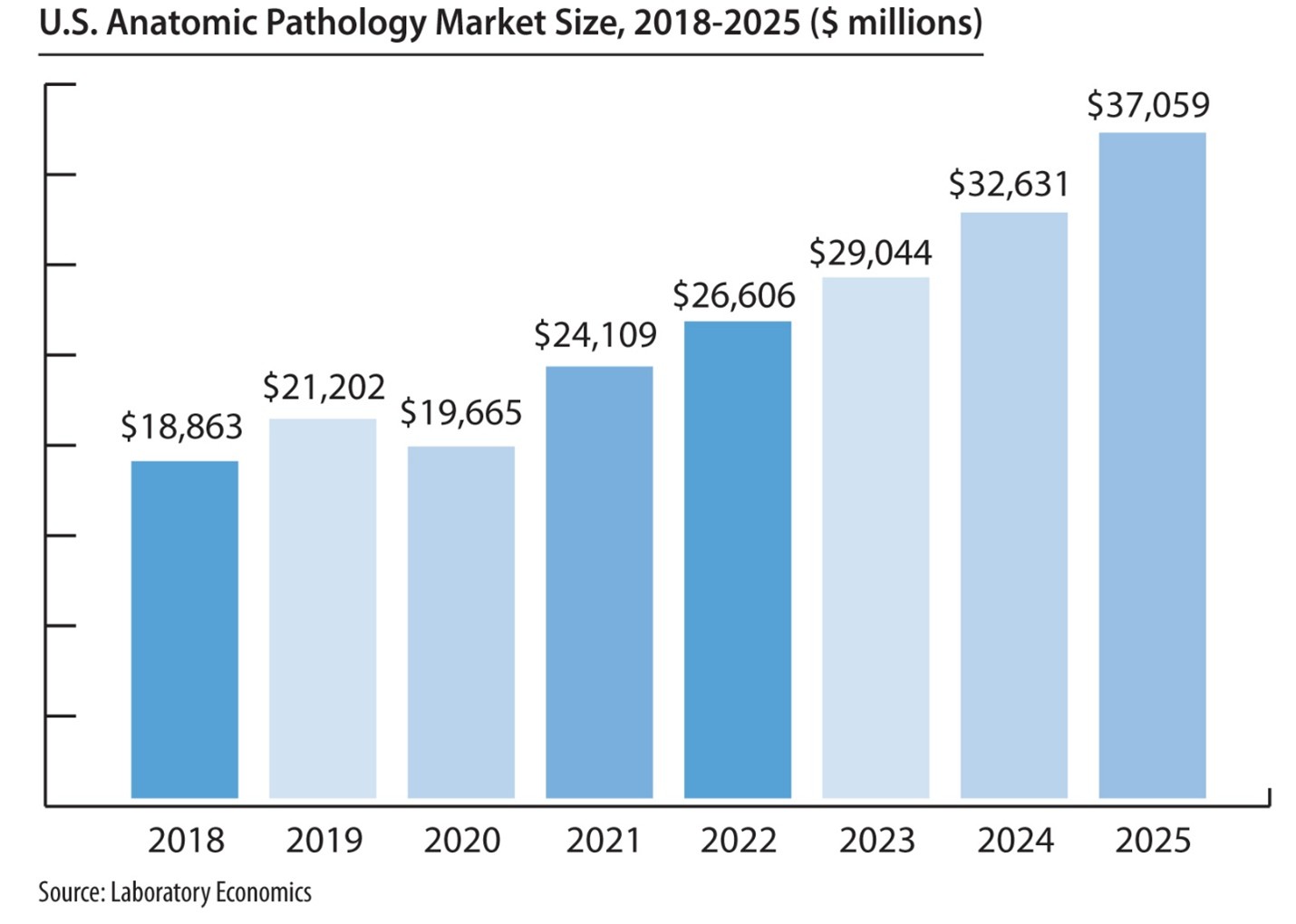
The report reveals that the U.S. anatomic pathology market represented an estimated $37.1 billion of revenue in 2025 with a long-term annual growth rate of 10.1%. Growth is being driven almost entirely by increased molecular oncology testing, especially minimal residual disease (MRD) testing to monitor cancer treatment.

The U.S. anatomic pathology market faces unprecedented change, including the introduction of artificial intelligence tools that increase pathologist productivity, greater utilization management by private payers and persistent reimbursement pressure.
 

“The introduction of new higher-priced molecular oncology tests, including next-generation sequencing for tumor mutation profiling and MRD testing, should more than offset price and volume pressure on routine pathology tests,” according to Jondavid Klipp, President of Laboratory Economics.

In addition, the growing adoption of digital pathology and application of AI software tools to digitized slide images have the potential to profoundly change the way pathology is practiced within the next 3-5 years.

The greatest challenge comes from third-party payers, which are instituting prior authorization policies and laboratory benefit management programs designed to lower utilization of anatomic pathology services and genetic tests for cancer.

The report includes:

  • More than 100 charts and graphs
  • Pathology market size and growth rates
  • Detailed estimates for market subsets like uropathology, dermatopathology, and gastrointestinal pathology
  • In-depth analysis of the molecular oncology testing market size and growth rates
  • Medicare claims data for 60+ key pathology codes covering surgical pathology, molecular oncology, immunohistochemistry and special stains, tumor marker immunoassays, FISH testing and flow cytometry
  • Cervical cancer testing trends and pricing data
  • Detailed analysis of the emerging digital pathology & AI market
  • Results from Laboratory Economics Anatomic Pathology and Clinical Lab Trends Surveys from 2015 through 2025

Anatomic pathology companies highlighted include:

  • Adaptive Biotechnologies
  • Bako Diagnostics
  • Caris Life Sciences
  • CellNetix Pathology & Laboratories
  • Exact Sciences
  • Foundation Medicine
  • Fulgent Genetics/Inform Diagnostics
  • Guardant Health
  • Labcorp
  • Mayo Clinic Laboratories
  • Myriad Genetics
  • Natera Inc.
  • NeoGenomics
  • OPKO/BioReference Labs
  • PathGroup
  • Quest Diagnostics
  • Sonic Healthcare/Aurora Diagnostics/ProPath Services
  • Tempus AI
  • Versant Diagnostics

The U.S. Anatomic Pathology Market: Forecast & Trends 2025-2028 is published by Laboratory Economics (http://www.laboratoryeconomics.com), an independent market research firm focused exclusively on the business of pathology and laboratory medicine. Report author Jondavid Klipp has been covering key business trends affecting clinical lab testing and anatomic pathology services for 27 years.

 

CAP Lobbies for 6.6% Medicare Rate Hike

CAP Lobbies for 6.6% Medicare Rate Hike

CAP Lobbies for 6.6% Medicare Rate Hike

 The College of American Pathologists (CAP), as well as the American 
Medical Association (AMA), are lobbying Congress to pass a bill that 
would hike Medicare payments to pathologists and other physicians by 
6.6%. The potential rate hike would become effective April 1, and would 
more than offset the 2.8% rate cut that took effect January 1, 2025.

CAP Lo Co o 6.6% M R Hk (cont’d from page 1) The bipartisan bill is called the Medicare Patient Access and Practice Stabilization Act of 2025 (H.R. 879). This bill would raise the conversion factor (CF) used to set Medicare rates for all physicians by 6.6% to $34.49 effective April 1. It would reverse the 2.8% payment cut that took effect on January 1, while also granting a payment adjustment for inflation plus a bump to reflect the lower CF in effect during the first quarter of 2025.

With the federal government facing a March 14 funding deadline, the best opportunity for passage is for this bill to be packaged with a larger spending bill to keep the government open, CAP President Donald Karcher, MD, tells Laboratory Economics. He says that the House could certainly pass it as a standalone bill because representatives have overwhelmingly supported similar Medicare payment increases for physicians in the past. But getting it through the Senate by itself would be challenging.

In addition to CAP and AMA, dozens of other physician groups support the bill, including the Medical Group Management Association (MGMA), the California Medical Association and the American Society for Clinical Pathology (ASCP).

The bill was introduced by Rep. Greg Murphy (R-NC) on January 31 and currently has 49 cosponsors (25 Republicans/24 Democrats).

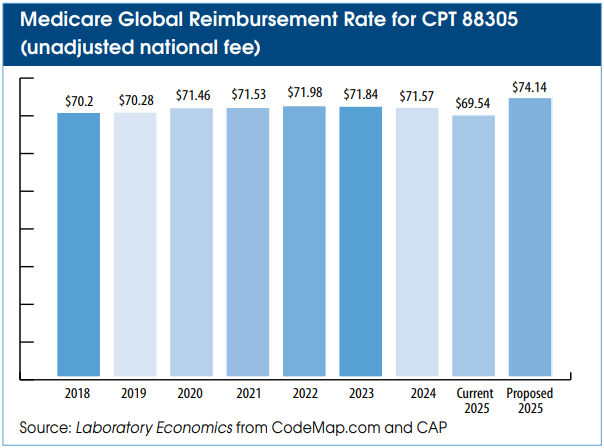
If passed into law, Medicare Physician Fee Schedule reimbursement for CPT 88305 (Level IV, tissue exam) would rise by 6.6% to a global rate of $74.14 from its current rate of $69.54. The Medicare rate hike would impact other pathology services as well as influence the rates paid by Medicaid and private health insurance plans.

Physician groups argue that a rate hike is needed to offset inflationary pressures. CMS has estimated that the Medicare Economic Index (MEI), a cumulative measure of the individual costs of running a practice, will increase by 3.5% this year after a 4.6% increase in 2024.

March 2024 CLIA Database

March 2024 CLIA Database

March 2024 CLIA Database

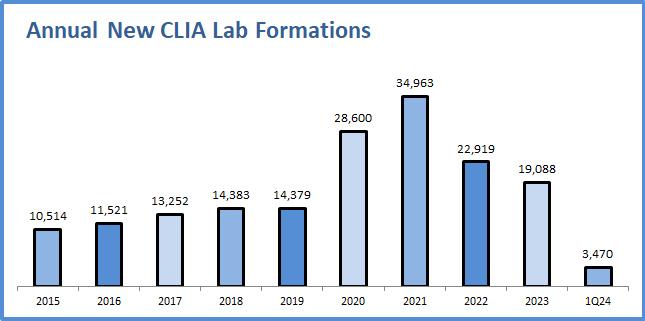
Laboratory Economics is offering a database of over 318,000 Clinical Lab Improvement Amendments (CLIA) certified laboratory facilities. The database is freshly updated as of March 31, 2024 and includes more than 8,000 independent labs, 122,000 physician-office labs, 9,000 hospital labs and all other labs. 

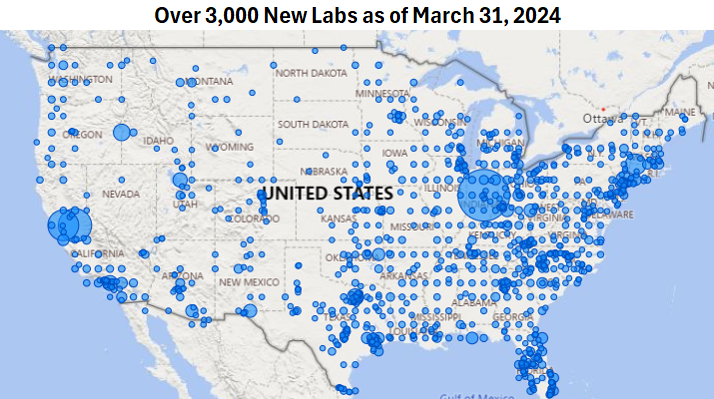
Importantly, the database includes all 3,470 new CLIA-certified labs that have been formed so far in 2024, including 231 new moderate/high-complexity labs and 3,239 waived testing labs. 

Metro areas showing the greatest number of new lab formations include New York City (202 labs), Seattle (180 labs), Los Angeles (159 labs), Dallas (122 labs), Miami-Ft. Lauderdale (120 labs), Houston (104 labs), Atlanta (74 labs) and Chicago (62 labs). 

A Must-Have for all vendors selling to medical laboratories!

  • Data is available for all 50 states and Puerto Rico
  • Includes all 7,000+ CAP-accredited labs
  • Find new customers to grow your sales
  • Create targeted lists by location or start date to focus on your best opportunities
  • Identify under served markets for geographic expansion
  • Save time and money by using accurate and up-to-date data

New Lab Formations Continue To Boom

New Lab Formations Continue To Boom

New Lab Formations Continue To Boom

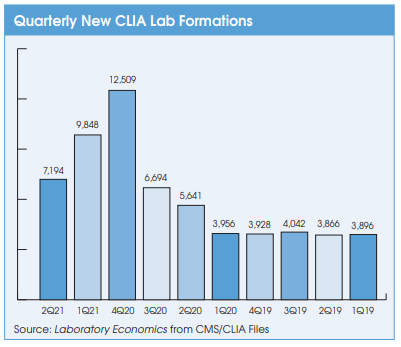
The extraordinary demand for Covid-19 PCR, antigen and antibody testing continues to fuel a record number of new CLIA-certified lab formations, according to the latest CMS data analyzed by Laboratory Economics. More than 7,000 new CLIA lab certificates were issued in the second quarter (April 1-June 30, 2021). The all-time high (12,000+ new CLIA labs) occurred in the fourth quarter of 2020. The boom has created a huge demand for lab workers that had already been in short supply before the pandemic.