The U.S. Anatomic Pathology Market: Forecast & Trends 2025-2028

The U.S. Anatomic Pathology Market: Forecast & Trends 2025-2028

The U.S. Anatomic Pathology Market: Forecast & Trends 2025-2028

Laboratory Economics has just released The U.S. Anatomic Pathology Market: Forecast & Trends 2025-2028. With this special report, you can tap into 100+ pages of proprietary market research that reveals critical data and information about key business trends affecting the anatomic pathology market.

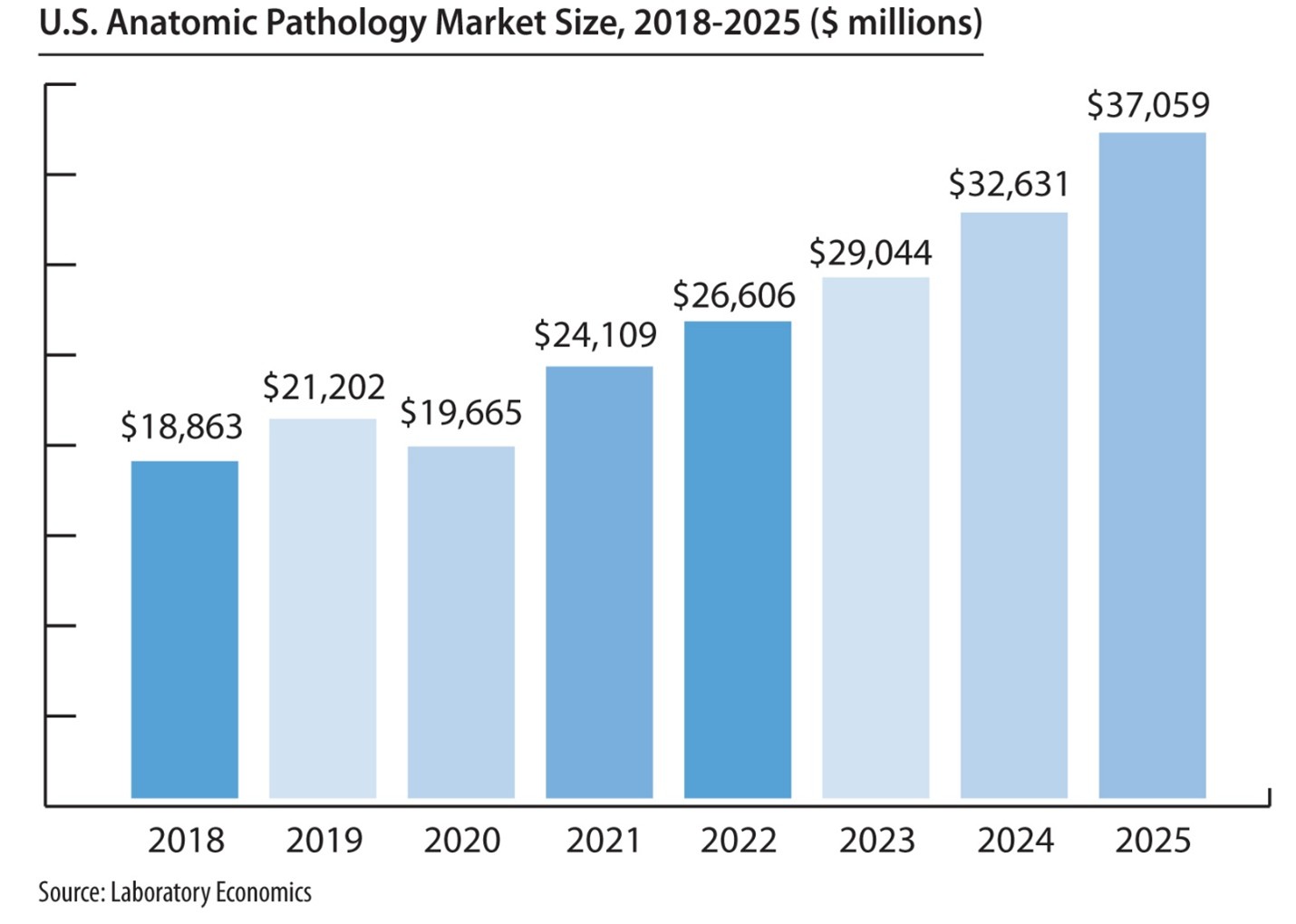
The report reveals that the U.S. anatomic pathology market represented an estimated $37.1 billion of revenue in 2025 with a long-term annual growth rate of 10.1%. Growth is being driven almost entirely by increased molecular oncology testing, especially minimal residual disease (MRD) testing to monitor cancer treatment.

The U.S. anatomic pathology market faces unprecedented change, including the introduction of artificial intelligence tools that increase pathologist productivity, greater utilization management by private payers and persistent reimbursement pressure.


“The introduction of new higher-priced molecular oncology tests, including next-generation sequencing for tumor mutation profiling and MRD testing, should more than offset price and volume pressure on routine pathology tests,” according to Jondavid Klipp, President of Laboratory Economics.

In addition, the growing adoption of digital pathology and application of AI software tools to digitized slide images have the potential to profoundly change the way pathology is practiced within the next 3-5 years.

The greatest challenge comes from third-party payers, which are instituting prior authorization policies and laboratory benefit management programs designed to lower utilization of anatomic pathology services and genetic tests for cancer.

The report includes:

  • More than 100 charts and graphs
  • Pathology market size and growth rates
  • Detailed estimates for market subsets like uropathology, dermatopathology, and gastrointestinal pathology
  • In-depth analysis of the molecular oncology testing market size and growth rates
  • Medicare claims data for 60+ key pathology codes covering surgical pathology, molecular oncology, immunohistochemistry and special stains, tumor marker immunoassays, FISH testing and flow cytometry
  • Cervical cancer testing trends and pricing data
  • Detailed analysis of the emerging digital pathology & AI market
  • Results from Laboratory Economics Anatomic Pathology and Clinical Lab Trends Surveys from 2015 through 2025

Anatomic pathology companies highlighted include:

  • Adaptive Biotechnologies
  • Bako Diagnostics
  • Caris Life Sciences
  • CellNetix Pathology & Laboratories
  • Exact Sciences
  • Foundation Medicine
  • Fulgent Genetics/Inform Diagnostics
  • Guardant Health
  • Labcorp
  • Mayo Clinic Laboratories
  • Myriad Genetics
  • Natera Inc.
  • NeoGenomics
  • OPKO/BioReference Labs
  • PathGroup
  • Quest Diagnostics
  • Sonic Healthcare/Aurora Diagnostics/ProPath Services
  • Tempus AI
  • Versant Diagnostics

The U.S. Anatomic Pathology Market: Forecast & Trends 2025-2028 is published by Laboratory Economics (http://www.laboratoryeconomics.com), an independent market research firm focused exclusively on the business of pathology and laboratory medicine. Report author Jondavid Klipp has been covering key business trends affecting clinical lab testing and anatomic pathology services for 27 years.


Laboratory Economics Issues Research Report On U.S. Laboratory Demographic Trends

Laboratory Economics Issues Research Report On U.S. Laboratory Demographic Trends

Laboratory Economics Issues Research Report On U.S. Laboratory Demographic Trends

Laboratory Economics has just released The U.S. Laboratory Demographic Trends & Strategic Outlook 2025-2028. With this special report, you can tap into 200 pages of proprietary market research that reveals critical data and information about key business trends affecting the U.S. laboratory testing market.

U.S. Laboratory Demographic Trends & Strategic Outlook 2025-2028

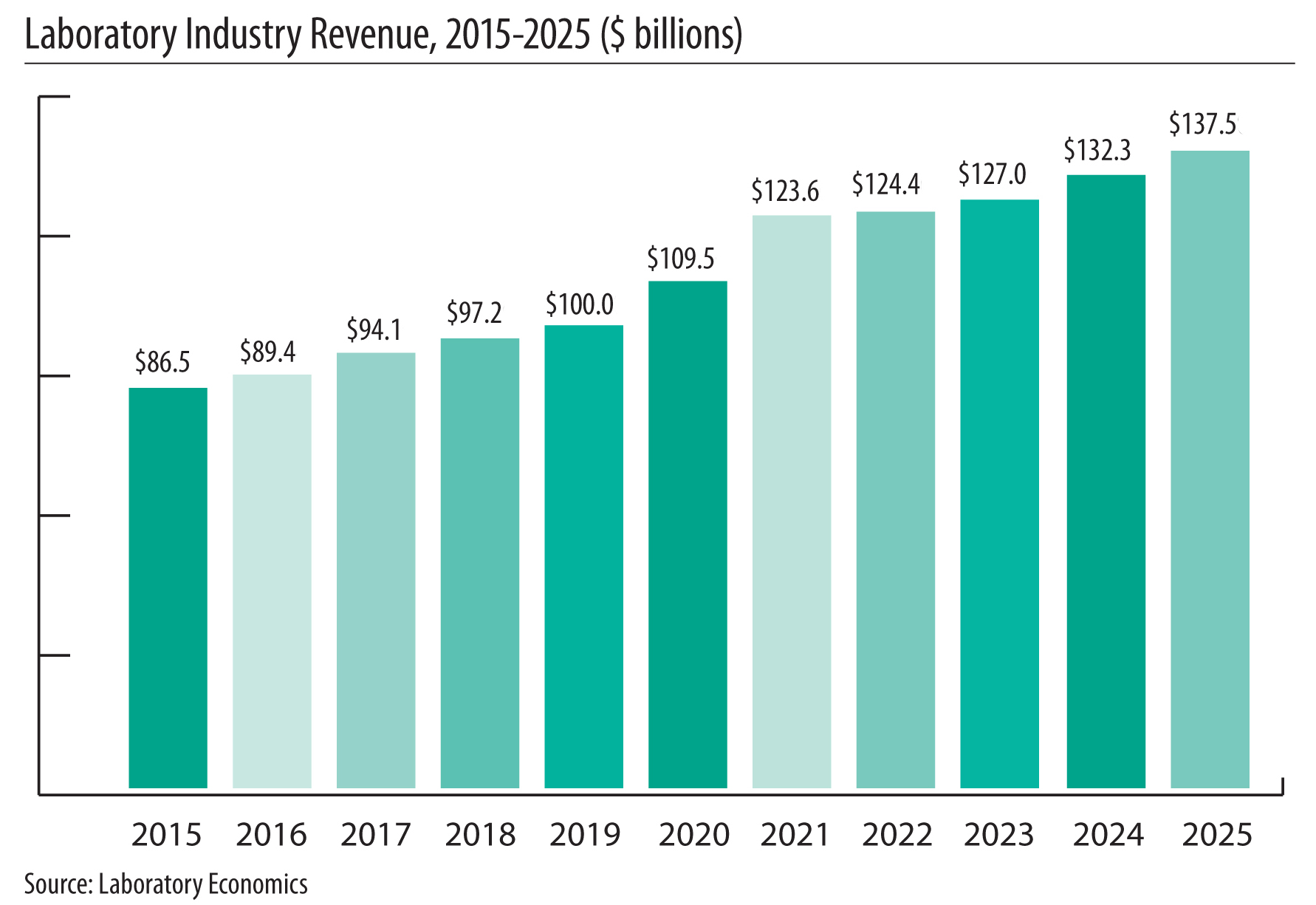
The report reveals that the U.S. laboratory testing market represented an estimated $137.5 billion of revenue in 2025 with a long-term annual growth rate of 3-5%. Growth is currently being driven mostly by increased PCR-based microbiology testing and next-generation sequencing (NGS) tests to analyze genetic changes in cancer cells

The fastest-growing geographic markets are all concentrated in the South
Central and Southeast regions, including Sarasota, FL, Austin, TX,
Raleigh, NC, Orlando, FL, and Jacksonville, FL.

The U.S. laboratory testing market faces big challenges, including
post-pandemic employee wage inflation combined with five straight years
of flat reimbursement rates from Medicare and commercial insurance
payers. “Despite these challenges, the U.S. lab industry has
demonstrated a long track record of consistent growth,” according to
Jondavid Klipp, President of Laboratory Economics.

U.S. Laboratory Demographic Trends & Strategic Outlook 2025-2028

New Market Research Report on U.S. Clinical Laboratory Market

New Market Research Report on U.S. Clinical Laboratory Market

New Market Research Report on U.S. Clinical Laboratory Market

Laboratory Economics has just released The U.S. Clinical Laboratory  Industry Forecast & Trends 2023-2025. With this special report, you can 
tap into 100+ pages of proprietary market research that reveals critical  
data and information about key business trends affecting the U.S.
laboratory testing market.

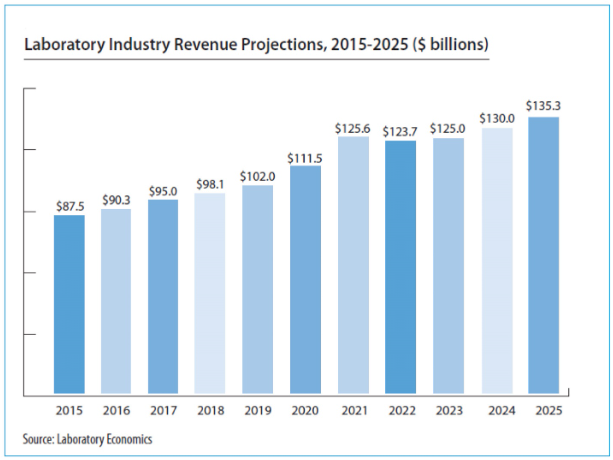
The report reveals that the U.S. laboratory testing market represented
an estimated $125 billion of revenue in 2023 with a long-term annual
growth rate of 3-4%. Growth is currently being driven almost entirely by
increased PCR-based microbiology testing.

The U.S. laboratory testing market faces unprecedented challenges,
including the post-pandemic employee wage inflation, greater utilization
management and claims denials by private payers and persistent
reimbursement pressure. Despite these challenges, the U.S. lab industry
has shown persistent growth.

“The adoption of new higher-priced PCR-based test panels for respiratory
viruses, UTIs and STDs is helping to offset price and volume pressure on
routine clinical lab tests,” according to Jondavid Klipp, President of
Laboratory Economics.

The report includes:

  • More than 100 charts and graphs
  • U.S. lab market size and growth rates for 2012-2025
  • Detailed estimates for market subsets like hospital-based labs,
    independent labs, and physician-office-based labs
  • In-depth analysis of the PCR-based testing market size, growth rate,
    and highest-volume laboratories
  • Top 50 hospital outreach labs by Medicare CLFS and PFS payments
  • Detailed reimbursement rate information from Medicare CLFS, Aetna,
    Cigna, UnitedHealthcare, etc.
  • Comprehensive lab M&A valuation metrics by revenue and EBITDA
  • Results from Laboratory Economics Clinical Lab Trends Surveys from
    2014 through 2023
  • The biggest challenges and opportunities for labs

Laboratory companies highlighted include:

  • ACL Laboratories
  • ARUP Laboratories
  • Exact Sciences
  • Fulgent Genetics
  • Labcorp
  • Mayo Clinic Laboratories
  • Myriad Genetics
  • NeoGenomics
  • Northwell Health Labs
  • OPKO/BioReference Labs
  • PathAI/Poplar Healthcare
  • PathGroup
  • Quest Diagnostics
  • Sonic Healthcare

The U.S. Clinical Laboratory Industry: Forecast & Trends 2023-2025 is
published by Laboratory Economics (www.laboratoryeconomics.com), an
independent market research firm focused exclusively on the business of
pathology and laboratory medicine.

Biopsy Client Database for Pathologists

Biopsy Client Database for Pathologists

Biopsy Client Database for Pathologists

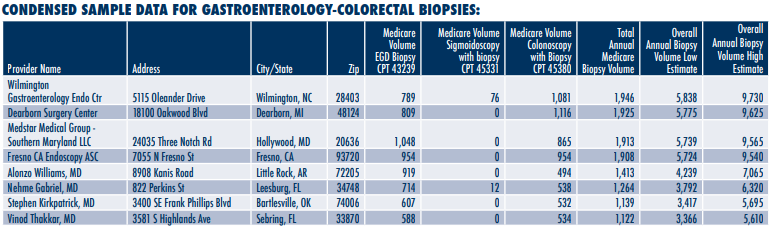
Laboratory Economics is offering a database of 50,000+ specialty physicians and ambulatory surgery centers that perform biopsies that lead to pathology referrals. The database includes annual Medicare Part B biopsy volumes for 2019 plus estimated overall biopsy volumes for each provider for 2021.

The database comes in easy-to-use and searchable Excel spreadsheets. It includes detailed biopsy volume figures for seven key specialty physician categories, including Breast Cancer (4,000+ providers), Cervix (600+ providers), Dermatology (18,000+ providers), FNA Biopsies (3,900+ providers), Gastroenterology/Colorectal (20,000+ providers), Urology/
Prostate (5,500+ providers) and Lung (2,000+ providers).

THE DATA IS PRESENTED IN A USER-FRIENDLY EXCEL SPREADSHEET AND INCLUDES:

• National Provider Identifier (NPI)
• Provider Name
• Address
• Specialty (Breast, Cervix, Dermatology, FNA Biopsies, Gastro/Colorectal,          Lung and Urology/Prostate)
• Specific Annual Medicare Biopsy Volume by CPT Code (2019)
• Overall Annual Biopsy Volume Estimates (2021)

PROVIDE YOUR SALES REPS WITH THE DATA THEY NEED TO SUCCEED! • Data for all 50 states and Puerto Rico
• Find new biopsy referral clients to grow your sales
• Create targeted lists by location or specialty to focus on your best opportunities
• Identify underserved markets for geographic expansion
• Save time and money by using accurate, complete and consistent data

CDx Diagnostics Leads In Digital Pathology

CDx Diagnostics Leads In Digital Pathology

CDx Diagnostics Leads In Digital Pathology

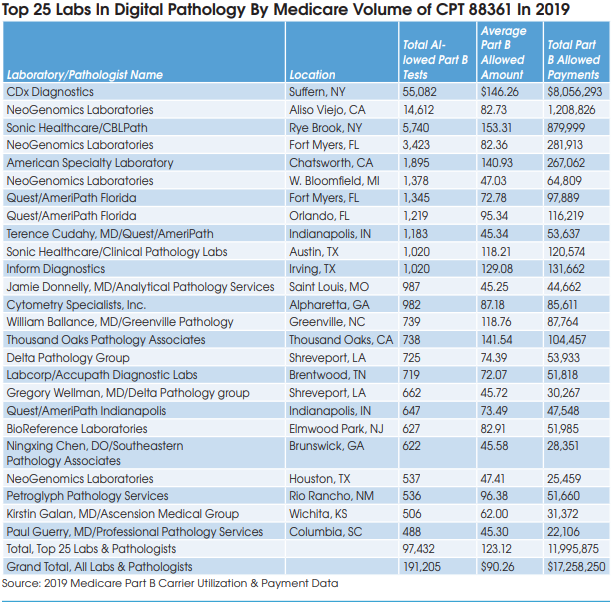
CDx Diagnostics (Suffern, NY), which specializes in oral, esophageal, and laryngeal cancer testing, is by far the biggest digital pathology lab as measured by volume of Part B claims for CPT 88361. CDx was paid for 55,082 Part B tests for CPT 88361 (including combined global, TC-only and PC-only claims) in 2019, according to provider utilization and payment data from CMS.

CPT 88361 is used to bill Medicare for digital quantification of HER2, estrogen receptor (ER), progesterone receptor (PR) and Ki-67 for breast cancer. This code can also be used for digital analysis of other cancers, including oral and esophageal cancers.

NeoGenomics has four labs (California, Florida, Michigan and Texas) in the top 25 with a combined total volume of 19,950 Part B allowed tests for CPT 88361 in 2019.

Sonic Healthcare USA has two lab locations (New York and Texas) that performed CPT 88361 with a combined volume of 6,760 allowed Part B tests for CPT 88361.

Overall, Medicare Part B allowed volume for CPT 88361 totaled 191,205 tests in 2019, down 10% from 212,003 tests in 2018.

Swedish Flag

NYSCLA Meeting Highlights:PAMA, Pandemic Response, Shortages & AI

NYSCLA Meeting Highlights:
PAMA, Pandemic Response, Shortages & AI

NYSCLA Meeting Highlights:
PAMA, Pandemic Response, Shortages & AI

Following cancellation last year due to the pandemic, the New York State Clinical Laboratory Association (NYSCLA) held this year’s annual meeting in a well-spaced conference room in Albany, October 6-7. Approximately 125 lab directors, managers, pathologists and vendors were in attendance—down from the average 200+ at pre-pandemic NYSCLA meetings. Key topics discussed included the outlook for the Medicare CLFS under PAMA, the New York clinical lab response to the pandemic, workforce shortages, and the risks and ethical challenges of using artificial intelligence in healthcare. Below are brief summaries of several speaker presentations.

Alan Mertz, Director of Government Relations at NeoGenomics (Fort Myers, FL), said the lab industry, led by the American Clinical Laboratory Assn. (ACLA), is lobbying to have Medicare CLFS rates frozen for another year in 2022. This would delay scheduled Medicare rate cuts of up
to 15% for most high-volume clinical lab tests, but would not change the second PAMA private payer data reporting period for labs of January to March 2022.

Another one-year delay would give the lab industry time to try to get legislative changes to PAMA that ensure that all lab providers (independents, hospitals and POLs) are accurately represented through statistical sampling when CMS calculates new CLFS rates for 2023-2025. Other changes sought by ACLA included limiting annual CLFS rate changes to between +5% and -5% per test, increasing the length of time between each data collection period from three years to four years, and excluding Medicaid managed care rates from future surveys.

Mertz noted that ACLA’s PAMA lawsuit against HHS/CMS, initially filed in December 2017, has been going on for nearly four years. Most recently, a federal district court dismissed the lawsuit in March, ACLA filed a notice of appeal in May, and hearings are expected to begin later this year.

Separately, Mertz noted that the lab industry has been trying to get clarity from the Department of Justice on the scope of the Eliminating Kickbacks in Recovery Act of 2018 (EKRA) for the past two years. A provision in the EKRA outlaws most traditional volume-based commissions paid to lab sales reps. EKRA was initially intended to target abusive kickback relationships between toxicology labs and addiction treatment centers. It doesn’t look like this will be enforced against legitimate labs, but a formal DOJ opinion is needed, according to Mertz.

Finally, Mertz said that ACLA is supporting the VALID Act, which would grandfather in existing laboratory-developed tests (LDTs), but require FDA regulation of new LDTs. This would be preferable to any potential FDA regulations that might be developed under the notice- and-comment
rulemaking process. Mertz believes the VALID Act has a chance to pass into law as an attachment to either a drug or medical device user fee reauthorization bill in 2022.

Brian Jackson, MD, Medical Director of Support Services, IT, and Business Development at ARUP Laboratories (Salt Lake City, UT), discussed the potential risks and ethical issues associated with using big data and AI in healthcare. Jackson noted how machine learning programs in
the past had developed biases as a result of being trained on non-diverse datasets. 

Violation of patient privacy is another risk. Jackson noted that Target and other retailers have developed algorithms so sophisticated that they can identify personal medical information based on an individual’s purchasing patterns. He cited a study that found that 99.98% of Americans could be correctly re-identified in any de-identified dataset by cross-referencing 15 demographic attributes (Nature, July 23, 2019).

Jackson warned that current FDA regulations of medical AI algorithms are too lax and require very little to achieve clearance. According to a study of 130 medical AI algorithms approved by the FDA between 2015 and 2020: 1) most were based on retrospective data only; 2) 93 out of the 130 devices had only single-site evaluation; and 3) only 17 reported that demographic subgroups were analyzed. [see Wu et al. Nature Medicine 2021;27:576-54]

Jackson urged labs to perform their own validation and quality control studies on new AI applications they deploy, just as they would when adding a new chemistry assay.

On the question of AI algorithms someday replacing pathologist interpretations, Jackson said pathologists may find themselves signing out more cases per day, but “I don’t see pathologists being
out of work any time in the near future.”

James M Crawford, MD, PhD, Senior Vice President of Laboratory Services at Northwell Health, noted that Northwell Health Laboratories (system-wide, inclusive of hospital lab-based and Core Lab-based testing, but not including rapid tests performed at Urgent Care Centers) is in the range of 5,000 to 8,000 Covid-19 PCR tests per day. Current positivity rates are hovering between 3% to 4%, according to Crawford.

Positivity rates had averaged more than 70% at Northwell Health at the peak of the pandemic in the New York City area in early April 2020. “We’ve probably never seen that high of a percentage positivity rate for any other pathogen,” noted Crawford.

He said that serological tests ordered by physicians and resulted by Northwell Health Laboratories are currently averaging about 90% positive for antibody tests for “Ig-S” (presumably a reflection of vaccination-related testing) and about 40% for antibody tests for “Ig-N” (presumably tests ordered to see whether a patient had recovered from natural infection). Crawford noted that this testing is from a population in which physicians wanted to know the test results and cannot be viewed as a “serosurvey” of the general population.

Crawford believes the New York City region will continue to see a steady rate of Covid-19 positivity, but that societal function and healthcare delivery will be relatively sturdy through the coming winter months. “Covid-19 will be with us for the foreseeable future. The key is staying committed
to our careful ways in co-existence with Covid-19.”

Carlos Cordon-Cardo, MD, PhD, Chairman, Department of Pathology, Molecular and Cell Based Medicine at Mount Sinai Health System (MSHS-New York City), described Mount Sinai’s transition to digital pathology. The timeline included the initial purchase order for Philips IntelliSite Pathology Solution in June 2019, integration of Philips-Sunquest and the MSHS LIS barcode system in late 2019, and going live for clinical diagnostics in early 2020. Labcorp, which acquired the MSHS clinical lab outreach business in 2017, helped with the digital pathology implementation. Cordon-Cardo says that MSHS pathologists are now using a combination of traditional microscope and digital pathology to interpret cases.

“Staffing has become the number one thing on everybody’s mind,” noted NYSCLA President Eloise Aita, PhD. She noted that approximately 50% of lab workforce is over the age of 55. Last year, the number of new NYS licensed clinical laboratory technologists fell by 17% to 304, while the number of new clinical lab technicians fell by 8% to 73. Challenges to attracting new workers include poor visibility of the specific occupations in the laboratory and limited job advancement opportunities, according to Aita. “The pandemic has shone a light on the importance of our industry, let’s take advantage of that.”