The U.S. Anatomic Pathology Market: Forecast & Trends 2025-2028

The U.S. Anatomic Pathology Market: Forecast & Trends 2025-2028

The U.S. Anatomic Pathology Market: Forecast & Trends 2025-2028

Laboratory Economics has just released The U.S. Anatomic Pathology Market: Forecast & Trends 2025-2028. With this special report, you can tap into 100+ pages of proprietary market research that reveals critical data and information about key business trends affecting the anatomic pathology market.

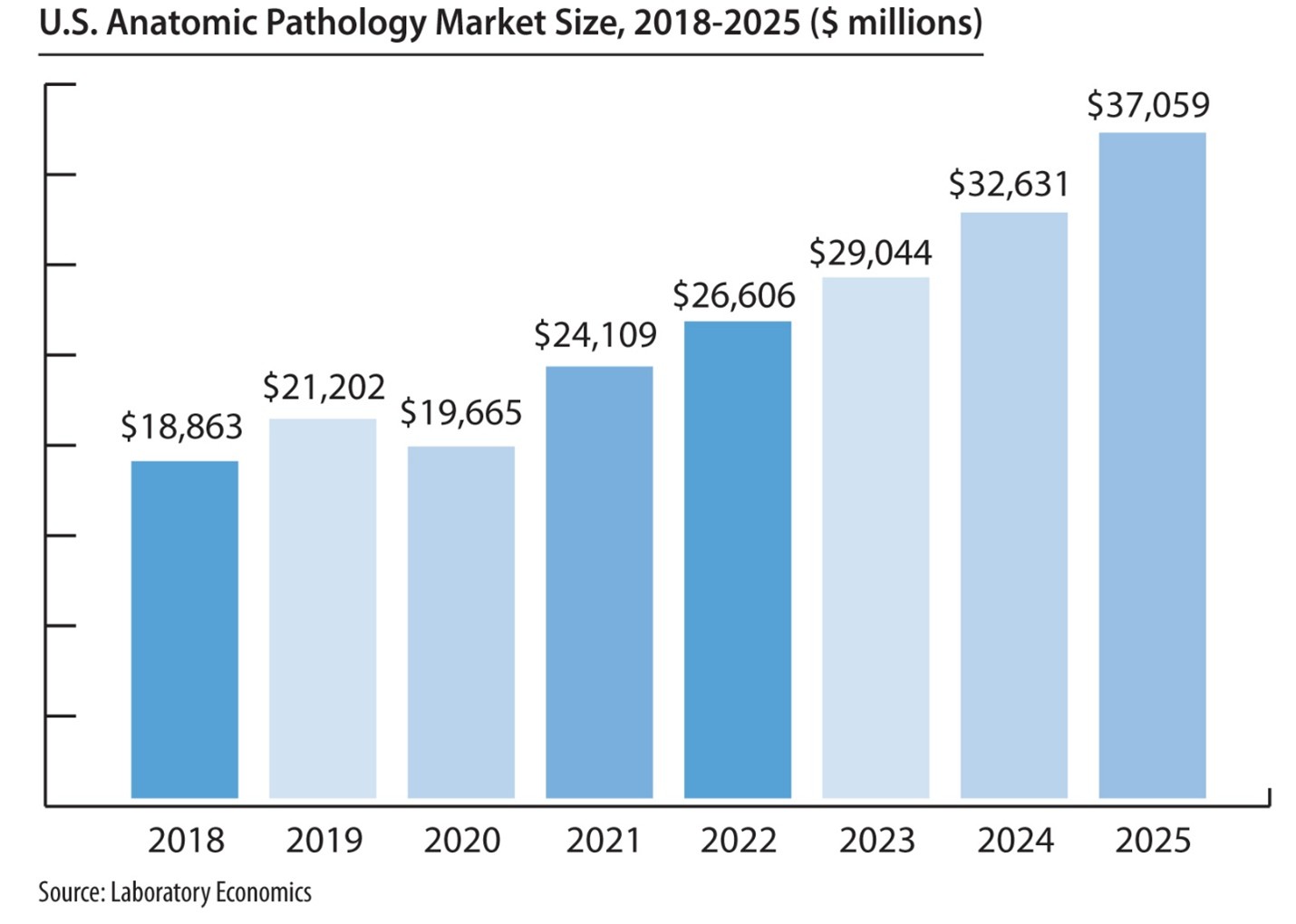
The report reveals that the U.S. anatomic pathology market represented an estimated $37.1 billion of revenue in 2025 with a long-term annual growth rate of 10.1%. Growth is being driven almost entirely by increased molecular oncology testing, especially minimal residual disease (MRD) testing to monitor cancer treatment.

The U.S. anatomic pathology market faces unprecedented change, including the introduction of artificial intelligence tools that increase pathologist productivity, greater utilization management by private payers and persistent reimbursement pressure.


“The introduction of new higher-priced molecular oncology tests, including next-generation sequencing for tumor mutation profiling and MRD testing, should more than offset price and volume pressure on routine pathology tests,” according to Jondavid Klipp, President of Laboratory Economics.

In addition, the growing adoption of digital pathology and application of AI software tools to digitized slide images have the potential to profoundly change the way pathology is practiced within the next 3-5 years.

The greatest challenge comes from third-party payers, which are instituting prior authorization policies and laboratory benefit management programs designed to lower utilization of anatomic pathology services and genetic tests for cancer.

The report includes:

  • More than 100 charts and graphs
  • Pathology market size and growth rates
  • Detailed estimates for market subsets like uropathology, dermatopathology, and gastrointestinal pathology
  • In-depth analysis of the molecular oncology testing market size and growth rates
  • Medicare claims data for 60+ key pathology codes covering surgical pathology, molecular oncology, immunohistochemistry and special stains, tumor marker immunoassays, FISH testing and flow cytometry
  • Cervical cancer testing trends and pricing data
  • Detailed analysis of the emerging digital pathology & AI market
  • Results from Laboratory Economics Anatomic Pathology and Clinical Lab Trends Surveys from 2015 through 2025

Anatomic pathology companies highlighted include:

  • Adaptive Biotechnologies
  • Bako Diagnostics
  • Caris Life Sciences
  • CellNetix Pathology & Laboratories
  • Exact Sciences
  • Foundation Medicine
  • Fulgent Genetics/Inform Diagnostics
  • Guardant Health
  • Labcorp
  • Mayo Clinic Laboratories
  • Myriad Genetics
  • Natera Inc.
  • NeoGenomics
  • OPKO/BioReference Labs
  • PathGroup
  • Quest Diagnostics
  • Sonic Healthcare/Aurora Diagnostics/ProPath Services
  • Tempus AI
  • Versant Diagnostics

The U.S. Anatomic Pathology Market: Forecast & Trends 2025-2028 is published by Laboratory Economics (http://www.laboratoryeconomics.com), an independent market research firm focused exclusively on the business of pathology and laboratory medicine. Report author Jondavid Klipp has been covering key business trends affecting clinical lab testing and anatomic pathology services for 27 years.


New PAMA Reform Bill Would Freeze CLFS Rates Through 2028

New PAMA Reform Bill Would Freeze CLFS Rates Through 2028

New PAMA Reform Bill Would Freeze CLFS Rates Through 2028

A bipartisan bill that would freeze Medicare Clinical Lab Fee Schedule (CLFS) rates for 2026-2028 and overhaul the way that future CLFS rates are determined was introduced on September 10.

The Reforming and Enhancing Sustainable Updates to Laboratory Testing Services (RESULTS) Act was proposed by Reps. Richard Hudson (R-NC), Gus Bilirakis (R-FL), Brian Fitzpatrick (R-PA) and Scott Peters (D-CA) in the House of Representatives. A Senate version has been introduced by
Sens. Thom Tillis (R-NC) and Raphael Warnock (D-GA).

ACLA President Susan Van Meter says it’s now critical for the entire lab industry to show support for the RESULTS Act by contacting members of the Senate Finance, House Ways & Means and especially the House Energy & Commerce committees. The goal is to get the RESULTS Act inserted
into a broader healthcare package expected to be passed later this year.

ACLA has not finalized its estimate of what it thinks the RESULTS Act might cost. A critical factor to gaining passage is Congressional Budget Office (CBO) scoring. The understaffed CBO will need to be convinced that the RESULTS Act has a reasonable chance of passage before it devotes the time and resources to analyze its cost. A high-cost estimate from the CBO could doom passage into law. 

Without new legislation, Medicare CLFS rate cuts of up to 15% for roughly 800 lab tests will take effect on January 1, 2026. In addition, independent labs, hospital outreach labs and large POLs will be required to report their private-payer volume and payment data from 2019 for approximately 1,500 lab test codes by March 31, 2026. CMS will use this data to determine Medicare CLFS rates for 2027-2029.

The RESULTS Act would:

  • Freeze Medicare CLFS rates at current levels for 2026-2028.
  • Medicare CLFS rates for 2029-2032 would be based on weighted median private payer rates from January 1 – June 30, 2027.
  • Labs would no longer be required to report their private-payer payment data.
  • Data would be supplied to CMS from a claims database (including at least 50 billion lab claims from >50 private payers) from an independent nonprofit entity (e.g., The FAIR Health Database).
  • Rate cuts would be limited to 5% per year with no cap on rate increases.
  • Private-payer payment data would be collected and analyzed every 4 years (instead of 3 years).
  • Special reporting rules would apply to non-widely available lab test codes
    (100 or fewer labs perform) and for Advanced Diagnostic Lab Tests (ADLTs)

ACLA’s Van Meter says that the RESULTS Act removes the reporting burden from labs and would help ensure that all lag segments are accurately represented [especially highly reimbursed hospital outreach labs]. Lobbying efforts are being focused on committee members (Senate Finance and House Ways & Means and Energy & Commerce) because their support is necessary to advance the bill.

Previous efforts at PAMA reform, including the LAB Act (introduced 2019) and SALSA (introduced 2022), were unsuccessful primarily because of their estimated costs. For example, the CBO had estimated that passing SALSA into law would cost $6 billion over 10 years.

Over the past five years (2021-2025), Medicare CLFS rates have been frozen because of a series of one-year delays. Previously, the CBO had scored one-year delays to save money under the erroneous assumption that private payer lab test rates were increasing in line with inflation. However, the CBO is updating its forecasting model for the CLFS and another one-year freeze is unlikely.

New PAMA Reform Bill Would Freeze CLFS Rates Through 2028

PAMA-Fix Bill Expected in Early September

PAMA-Fix Bill Expected in Early September

An early start to summer recess for Congress thwarted the potential
for introduction of a PAMA-fix bill in July. ACLA President Susan Van Meter is now anticipating that PAMA-reform advocates in the House and Senate will introduce bills after Congress returns in early September. The hope is that PAMA-reform language can be attached to a larger healthcare bill this fall.

Should there be no progress here by October, the lab industry is likely to push for another one-year delay, or even a six-month delay. Without new legislation, Medicare CLFS rate cuts for nearly 800 lab tests will take effect on January 1, 2026. In addition, independent labs, hospitals and large POLs will be required to report their private-payer volume and payment data for 1,447 lab test codes by March 31, 2026.

CMS will use this data to determine Medicare CLFS rates for 2027-2029.

The Outlook for Medicare CLFS Rates

The Outlook for Medicare CLFS Rates

The Outlook for Medicare CLFS Rates

Without legislative action, Medicare rates for nearly 800 lab tests 
will be cut by up to 15% effective January 1, 2026. “A lot of labs 
have become complacent after five straight years of Medicare CLFS rate 
freezes,” says Mark Birenbaum, PhD, Executive Director of the National  Independent Lab Association (St. Louis, MO). “But they need to start  thinking about the potential for rate cuts next year.”

Birenbaum says that NILA is working with the American Clinical Laboratory  Assn. to introduce a new “PAMA-fix” bill within the next month or two. Any new bill would seek to delay the scheduled Medicare CLFS rate cuts for  2026 and ensure that hospital lab rates are correctly represented 
in future private-payer payments surveys and rate calculations. 
It’s too late to get a PAMA-fix into the Big Beautiful Bill currently being  debated in the Senate. 

The hope is that a PAMA-fix could get inserted into a major government  funding or healthcare policy bill at the end of the year. But this will be a  tough hill to climb, and time is running short. 

Here’s an outline of three possible scenarios: 

Scenario 1: PAMA Proceeds as Scheduled by Law
The first PAMA survey, which was based on private-payer lab rates from  2016, resulted in three straight years (2018-2020) of 10% cuts to most lab  tests on the Medicare CLFS. A second PAMA survey and additional rate cuts  were then frozen for five straight years (2021-2025). 

Under current law, Medicare CLFS rates for approximately 800 lab tests will be reduced by up to 15% on January 1, 2026. See table on page 4. 

In addition, the second PAMA survey is scheduled to begin on January 1,  2026. Independent labs, hospitals and large POLs are required to submit  their private-payer volumes and reimbursement rates from the period  January 1, 2019 to June 30, 2019 to CMS by March 31, 2026. CMS will use 
this data to calculate new median private-payer rates to set the Medicare CLFS for 2027-2029.

Scenario 2: A PAMA-Fix is Introduced and Passed into Law
Despite widespread support from both Democrats and Republicans, the  last PAMA-fix bill SALSA (H.R. 2377/S. 1000) failed to get passed into law. The  culprit was cost. The Congressional Budget Office (CBO) had projected that  passing SALSA into law would cost $6 billion over 10 years. A separate  analysis by ACLA had estimated the cost at less than $3 billion. 

ACLA is now crafting a new PAMA-fix proposal and seeking supporters to  introduce it. A simpler and less costly alternative to SALSA is what’s needed. 

There is little argument that current PAMA law pertaining to labs is  unworkable. In particular, it will be nearly impossible for most hospital labs  to dig up their private-payer volume and payment data from 2019 and  report it to CMS, notes Josh Kramer, Managing Partner at the laboratory IT  company Leap Consulting Group (Teaneck, NJ). Kramer says that many  hospitals have gone through system upgrades and changes since 2019 and these hospitals may not have historical claims data readily available from  legacy systems. In addition, PAMA does not allow hospitals to ignore paper  claims data. And smaller hospitals may not have detailed lab data from  paper claims loaded in their systems at all, according to Kramer. 

A new PAMA-fix bill will need to include a mechanism (e.g., statistical  sampling) to ensure that the higher rates paid to hospital labs are  accurately surveyed and included in CLFS rate calculations. 

Scenario 3: CLFS Remains Frozen and PAMA is Delayed Another Year
In previous scoring of one-year delays in PAMA payment cuts and reporting, the CBO assumed that private payers were adjusting their lab test reimbursement rates for inflation. Based on this assumption, the CBOconcluded that the suspension of PAMAwould result in cost savings.  The CBO is no longer assuming private payer inflation updates. As a result,  another one-year PAMA delay is unlikely to be scored to provide savings and  thus unlikely to be passed into law.

Is Alzheimer’s Testing the Next Big Lab Market?

Is Alzheimer’s Testing the Next Big Lab Market?

Is Alzheimer’s Testing the Next Big Lab Market?

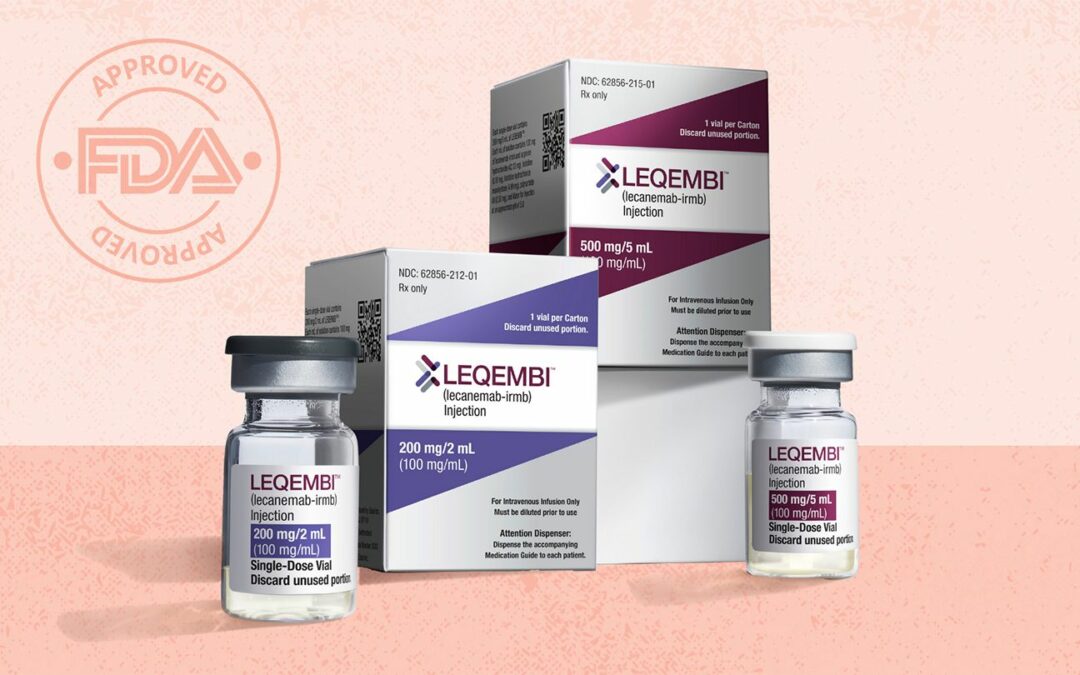
The FDA cleared the Alzheimer’s drug Leqembi (lecanemab) in July 2023. The drug marked the first treatment for slowing Alzheimer’s progression and cognitive decline to make it through the agency’s traditional pathway. But Leqembi, which was developed by Eisai (Tokyo) and Biogen (Cambridge, MA), has fallen far short of its goals for patient prescriptions. That’s partly because the current methods for diagnosing Alzheimer’s—ex- pensive brain imaging scans and invasive cerebral spinal fluid (CSF) tests— are acting as bottlenecks. However, new blood tests for Alzheimer’s are
being introduced that could give more patients access to treatment.

An estimated 6.9 million Americans aged 65 and older are currently living with Alzheimer’s disease, according to the Alzheimer’s Association (Chicago, IL). And an estimated 500,000 new cases of Alzheimer’s will be diagnosed this year. The new Alzheimer’s treatment Leqembi has a list price of $26,500 per year.

In addition, the FDA recently cleared Eli Lilly’s Alzheimer’s drug Kisunla (donanemab), which has a list price of $32,000 per year. Both drugs are intravenous infusions that attack a protein (amyloid) that clumps into plaques in the brains of people with Alzheimer’s. Both drugs slow disease progression (e.g., memory loss or other cognitive problems) but do not stop or reverse it. In addition, at least nine pharmaceutical companies have clinical trials underway for new Alzheimer’s drugs. Those in late-stage trials for oral pill treatments include BioVie (NE3107) and AB Science (masitinib).

But these drugs rely on PET scans and CSF tests to identify Alzheimer’s patients for treatment. “The availability of more affordable and minimally invasive diagnostic tools will help support broad access for the management of Alzheimer’s disease,” according to Eisai’s global Alzheimer’s disease officer, Keisuke Naito.

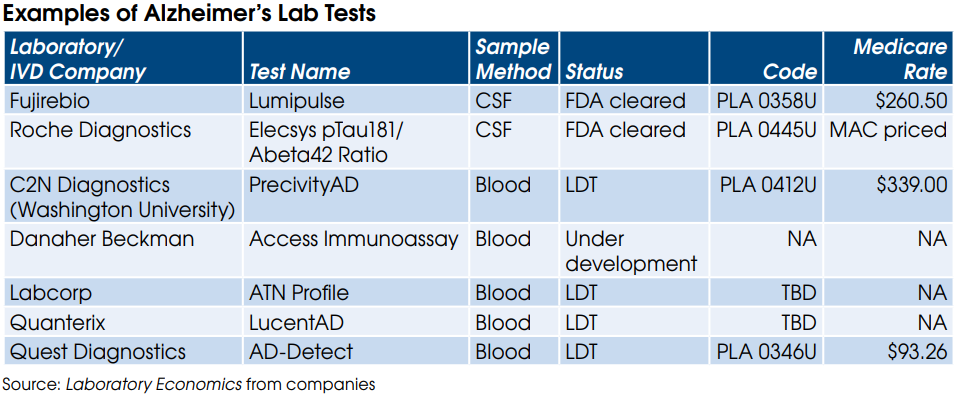
New blood-based immunoassays that identify the proteins associated with Alzheimer’s are likely to become the new standard for screening and monitoring the disease. The potential lab market could reach $500+ million per year. This estimate assumes 4 blood tests to identify and monitor each of the 500,000 new cases of Alzheimer’s each year at an average reimbursement of $260 per test (for two protein markers per test).

At the June 25th Annual CLFS Meeting with CMS to address rate setting for new codes, ACLA requested a Medicare rate of $130 per Alzheimer’s protein marker. Thus, a two-protein test (e.g., pTau181 & Abeta42) would be reimbursed $260. This level of reimbursement would match the Medicare rate of $260 for Fujirebio’s FDA-cleared Lumipulse test. Coding and final rates will be announced by CMS later this year for an effective date of January 1, 2025.

There are currently at least six Alzheimer’s lab tests on the market (see table). In addition, Danaher’s Beckman Coulter is developing a blood test for its immunoassay analyzers. Beckman is expected to release a two-protein test (pTau217 & Abeta42) in RUO format later this year. Clinical data from the RUO test will be used to support an eventual FDA application.

FDA Final LDT Rule Could be Published Soon

FDA Final LDT Rule Could be Published Soon

FDA Final LDT Rule Could be Published Soon

On March 1, the FDA submitted its final rule for LDT regulation to 
the White House’s Office of Information and Regulatory Affairs 
(OIRA). This is a perfunctory last step before the final rule is published
in the Federal Register. This could occur as soon as April 1. This will be
the most impactful new regulatory change for laboratories since PAMA
completely overhauled the Medicare CLFS in 2018.

FDA FINAL LDT RULE COULD BE PUBLISHED SOON

OIRA (pronounced “oh-eye-rah”) is a statutory part of the Office of Management and Budget within the Executive Office of the President. OIRA is responsible for reviewing all federal regulations (i.e., the Executive Branch’s administrative actions) to ensure they meet all statutory requirements. OIRA is currently headed by Richard Revesz, Administrator, who was appointed by President Biden and confirmed by the U.S. Senate in late 2022.

“OIRA reviewed the proposed rule in record time, so it is reasonable to expect that the review of the final rule will not be protracted. I would not be surprised if OIRA completes its review in 30 days and FDA publishes the final rule in the federal register in the first week of April,” according to attorney Sheila Walcoff, Chief Executive at the IVD consulting firm Goldbug Strategies (Gaithersburg, MD).

Typically, a final rule will specify an effective date of 30 or 60 days after the publication date, adds Walcoff.

Once a final rule is published it will be difficult to overturn.

Last Chance to Sway OIRA Against Regulation 

OIRA staff held nine teleconferences with organizations advocating both for and against FDA LDT regulation last year. OIRA is next scheduled to meet with The Association for Diagnostics and Laboratory Medicine (ADLM — formerly AACC) on March 18. ADLM, which represents approximately 8,000 members, including clinical labs and IVD manufacturers, has steadfastly
opposed FDA regulation of LDTs. This could be the last chance that the lab industry has to sway OIRA against rubber-stamping the final rule.

Expected Legal Challenge

A final rule is almost guaranteed to trigger a lawsuit from lab trade groups, which will argue that the FDA does not have the authority to regulate LDTs.
The American Clinical Laboratory Assn. (ACLA — Washington, DC) seems to be gearing up for a lawsuit to the impending final rule. In a statement, ACLA President Susan Van Meter said:

ACLA has significant concerns about the legality and impact of FDA unilaterally imposing an ill-fitting medical device scheme on laboratory-developed testing services, which are professional services and not medical products. Should the agency promulgate a final rule, ACLA will assess its options at that time; but we continue to urge the agency to withdraw the proposed rule and reengage on advancing appropriate legislation.

Could a New Trump Administration Put the Kibosh on LDT Regulation?

As a component of OMB, OIRA is part of the Executive Office of the President and helps ensure that covered agencies’ rules reflect the President’s policies and priorities.

The FDA is moving quickly because the national election in November could result in a new administration opposed to LDT regulation. A new President could, immediately upon taking office, prevent a proposed rule from being finalized, according to long-time lab regulation expert Dennis
Weissman (Falls Church, VA).

However, Weissman says that changing or canceling a final rule is much more difficult. Once a federal rule has been finalized a new administration would be required to undergo the formal rulemaking process (i.e., opportunity for public comment on a proposal followed by final rule) to change or repeal all or part of a final rule.

In addition to this administrative action, Congress could also take legislative action to overturn a final rule, notes Weissman.